

Interview: Talking Stone with Liz Laycock

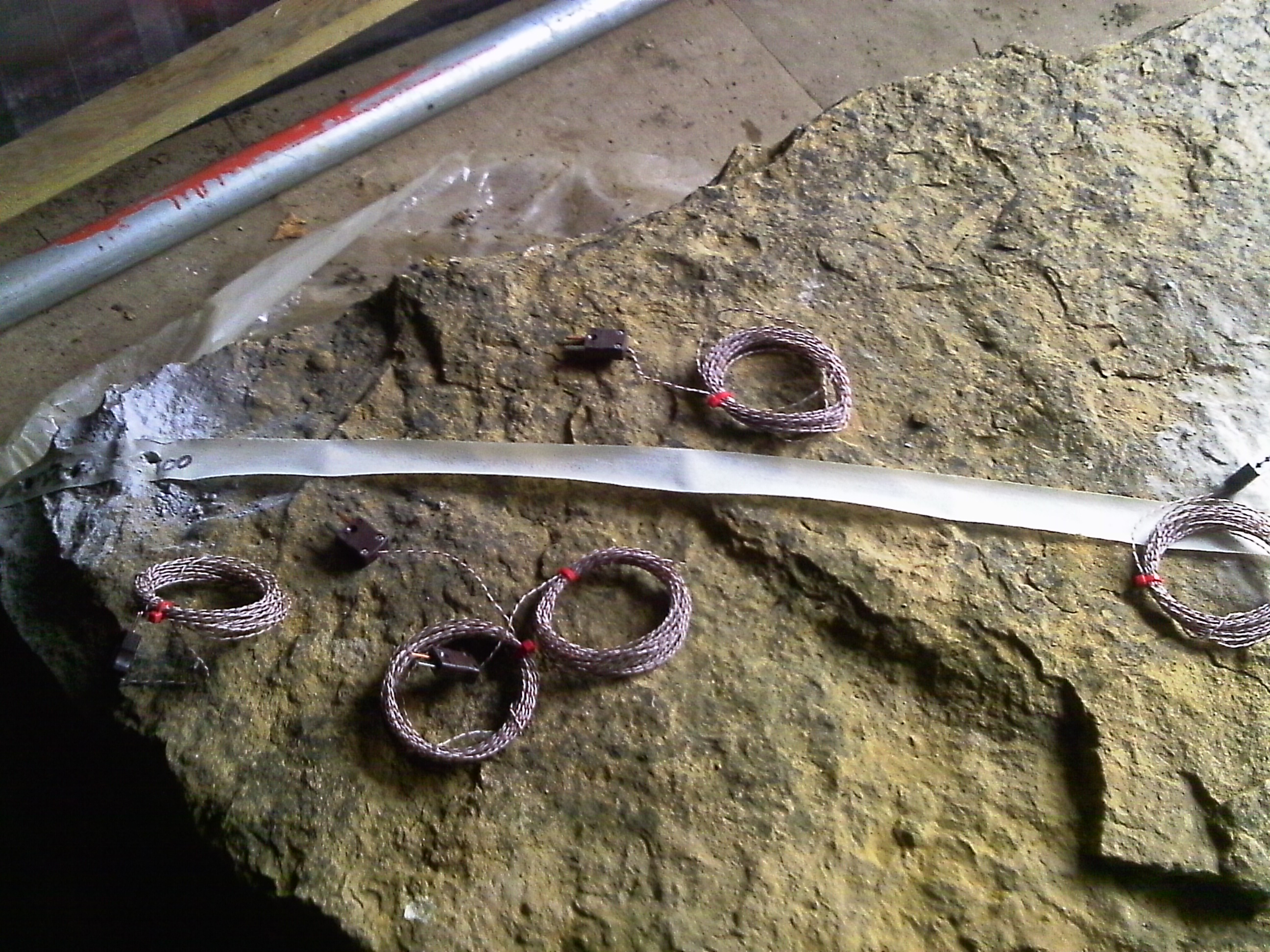
When it comes to stone, Liz Laycock knows her stuff. With a First degree in Industrial Geology from the University of Exeter’s Camborne School of Mines, and a PhD from the University of Sheffield, Earth Sciences, she has found herself teaching others at Sheffield Hallam University. Operating from the School of Engineering and Built Environment, she shares her knowledge on the BSc for Building Surveying, Construction Project Management, and Quantity Surveying degree courses, as well as some of the Apprenticeship routes.
She caught our attention when launching the schools Stone Library earlier this year, and we were lucky enough to find out more about her work, and to soak up some of her unique insights about the industry.

JB: Let’s start with some of your recent work at the university, which we shared a few months back as you launched it: The Stone Library. It's a treasure trove of stone donated by brothers Geoff and Scott Engering. But can you tell me a bit more about your plans for it in the future, and how students and others will be able utilise it?
LL: The Stone Library was established with the Architecture and Interior Architecture and Design students in mind, as well as my own students and the cohorts I have direct connections to. It was created to be an accessible and visually attractive installation that showcases some of the very best of British building materials. Each stone sample has a QR code that links to a web page with further information. My overall aim is to link the online content with the BGS database and also to current suppliers (where these exist). Currently, the main links are to the Historic England County and Area guides and their databases. I do feel it is important to look forward as well as back, and encourage future new build use. While the main use of the library will be for our own students, I also hope that it will attract visitors to the university, and I hope it will be of use to external consultants. I really want to demonstrate the variety we have in our indigenous building materials.
Students look around new builds and see a lot of use of glass, brick, steel, or concrete, and can be a little blind to alternatives. If we are serious about reducing the transport-related carbon content of our built environment, I really can't see why natural building stone doesn't have far more traction in the market. Stone lends a sense of place and distinction to a building, be that it's using local resources to blend with and complement the existing materials or making a statement building that stands out
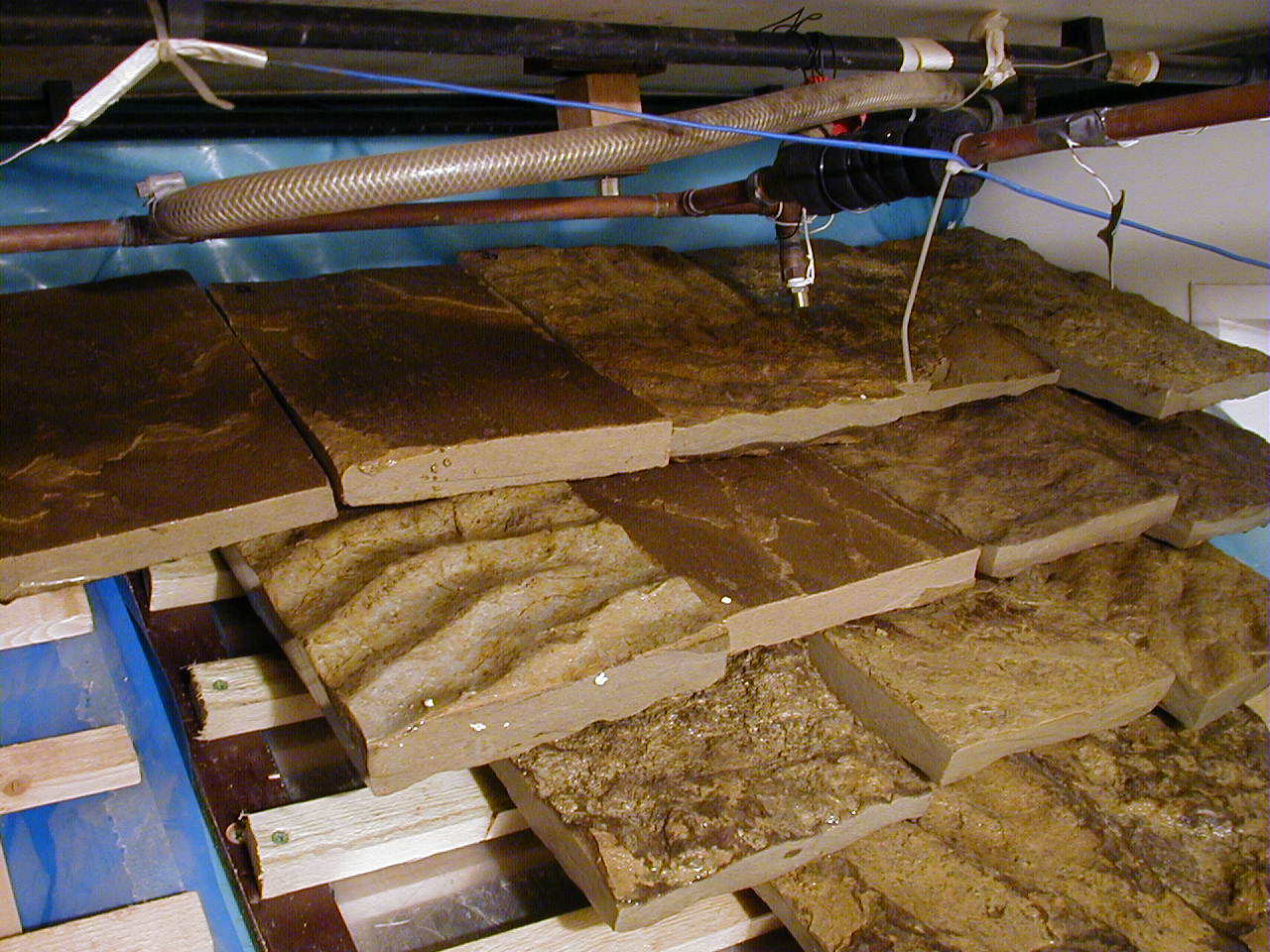
JB: Your own research around stone is fascinating, and I’m sure our readers will be intrigued to know more. Can you tell me a bit more about the work you’re doing with frost to split stone?
LL: The splitting of stone into tiles has been done on several different types, but the best example is Collyweston. As I’m sure you are aware, the stone roof tile industry was considered pretty much extinct in the 1990’s, and repair of historic buildings was largely done by recycling tilestones from demolished roofs. Traditionally, the stone was split by allowing the freshly-extracted stone ‘log’, worked over the winter period, to be exposed to sharp frosts while being kept in a damp condition. Operating over a number of years, the work we did at Hallam allowed an artificial frosting cycle to be developed, first used for the re-roofing of Apethorpe Hall, carried out by Messenger construction. Within the development work we did, we showed that the stone tiles split by artificial splitting did not continue to degrade in use.
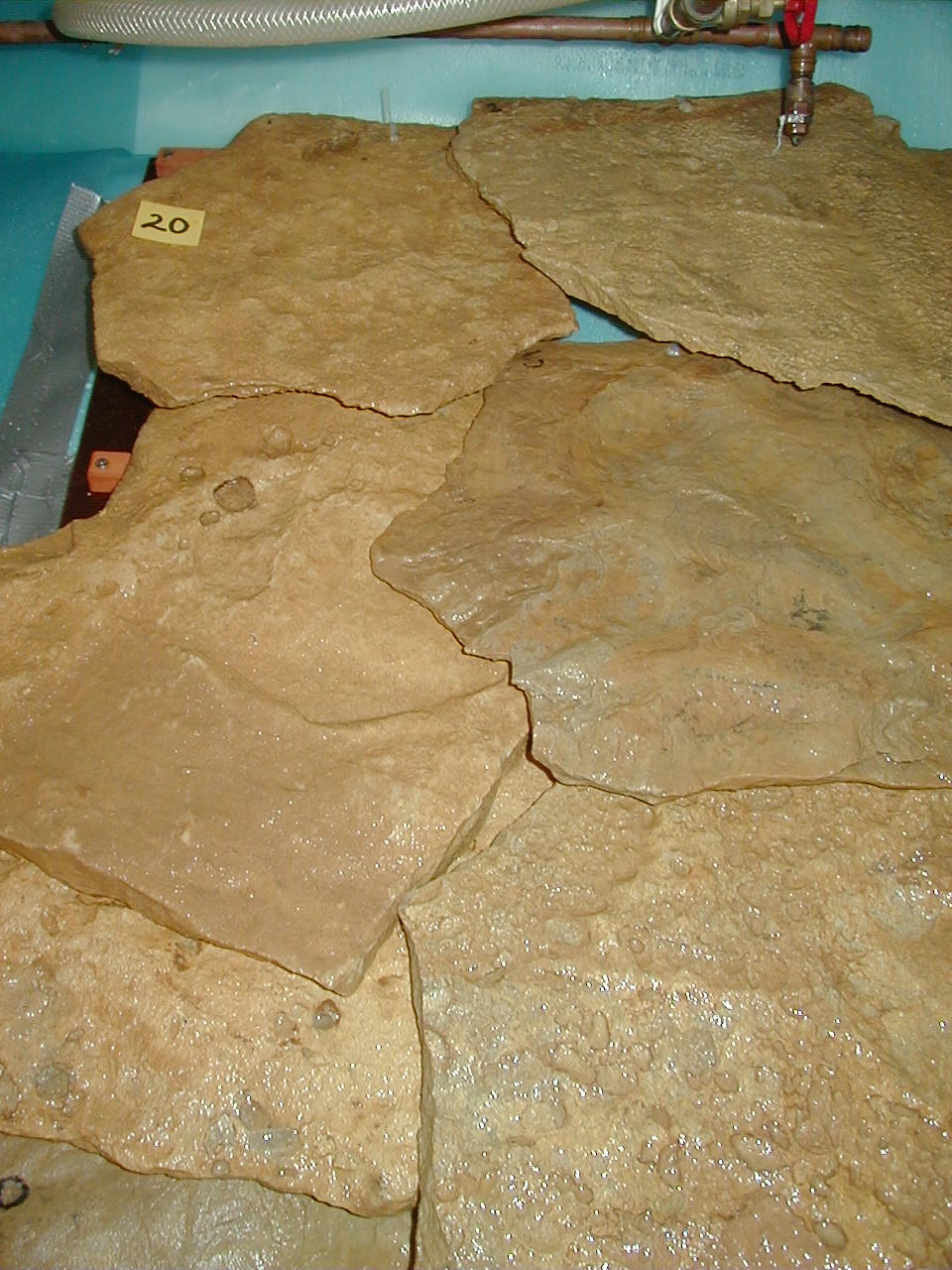
Artificially Split Tiles
JB: Another great example of stone in action! But what are some of the biggest challenges you feel the industry and, with it, your students face when it comes to working with stone?
LL: I think one of the key problems with getting students to start thinking about using stone is that the industry they're going into is very much enamoured with the idea of measuring overall value solely in terms of simple bottom line costs rather than looking at whole life costing or added value. When cost becomes a controlling factor, it's so much more tempting for people to revert to simple manufactured products, or if they do stick with stone, they look for cheap and therefore imported ones. It seems problematic to me to continue to use imported stone that matches our own resources. But at the moment, there seems to be an overall failure to recognise the longevity, durability and flexibility of masonry. Simply by increasing levels of insulation, it should be possible to meet thermal performance criteria. The focus on novel forms of lightweight construction, volumetric prefab and other new technologies will almost inevitably become problematic in a decade or two – a recurrent theme in construction.
JB: The more I talk to people in the industry, the more of a mystery it becomes as to why not more people are choosing to specify and work with stone. Why do you think that is?
LL: There are of course problems - construction trade skills are undersupplied in the current market, which has been a push factor for pre-fabricated components. In turn, this skill deficit makes use of masonry potentially more expensive and creates a downward spiral. The main push back is from consumers who appear to have more faith in traditional build – probably because a property represents the single biggest personal investment most people make. I do wonder that people are now very much removed from an understanding of the materials around them and the supply chains that support these. Perhaps this is an aspect that industry needs to take on: educating customers to move towards a much more integrated and national supply basis, where we seek to maintain the flow of money within our economy rather than allowing money to flow out. This is obviously profitable now – and can certainly be justified for premium materials which do not occur in the UK – but perhaps not so much for the numerous sandstones and limestones that occur here.
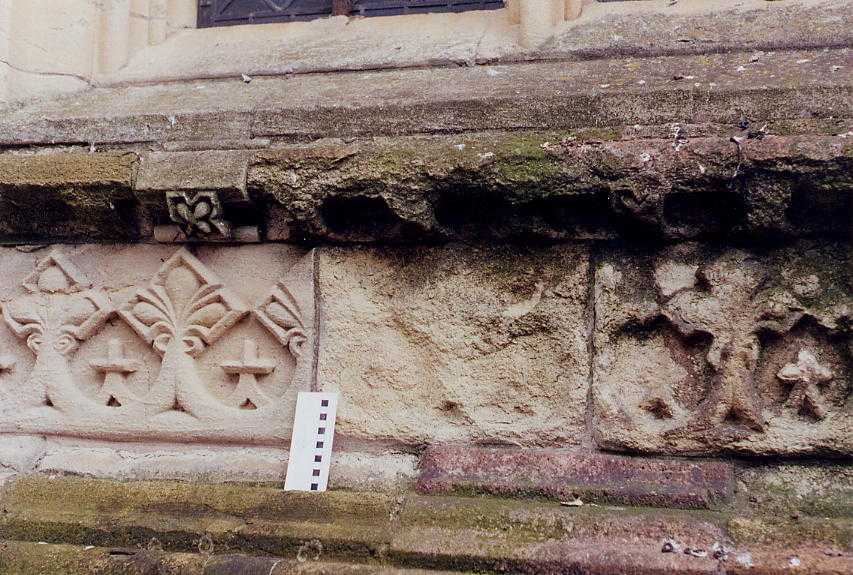
Research at Truro Cathedral
JB: In a world where consumers and specifiers are increasingly on the lookout for materials that offer reduced ecological impact, what do you say to those who question stone’s inherent need for extractive processing?
LL: Public perception is always going to be a problem with any extractive industry. I'm afraid that the UK population may indeed have a slightly NIMBY attitude, but that could be driven by a perception of what a commercial stone quarry would look like based on comparisons to the sizes of commercial aggregates extraction sites. Local sentiment is easy to sway as visions of convoys of trucks travelling through remote rural villages are painted by those opposing the scheme. And yes, any industry will have a need to transport goods. Yet at the same time, ironically, the same people will drive past an abandoned quarry and either not notice it or indeed drive to it to visit it because it now forms part of our valued wildlife-rich landscape. It's a shame people can't see that, effectively, stone quarrying is a borrowing of the land. The quarry is reducing the land level without significantly affecting the environment, and from it, new and possibly more valuable resources could be the result. At the end of life, with some careful consideration, the resulting landform could provide space for homes, habitats for wildlife or any combination. This is effectively using the same land at least twice, winning the materials and then re-using the site.
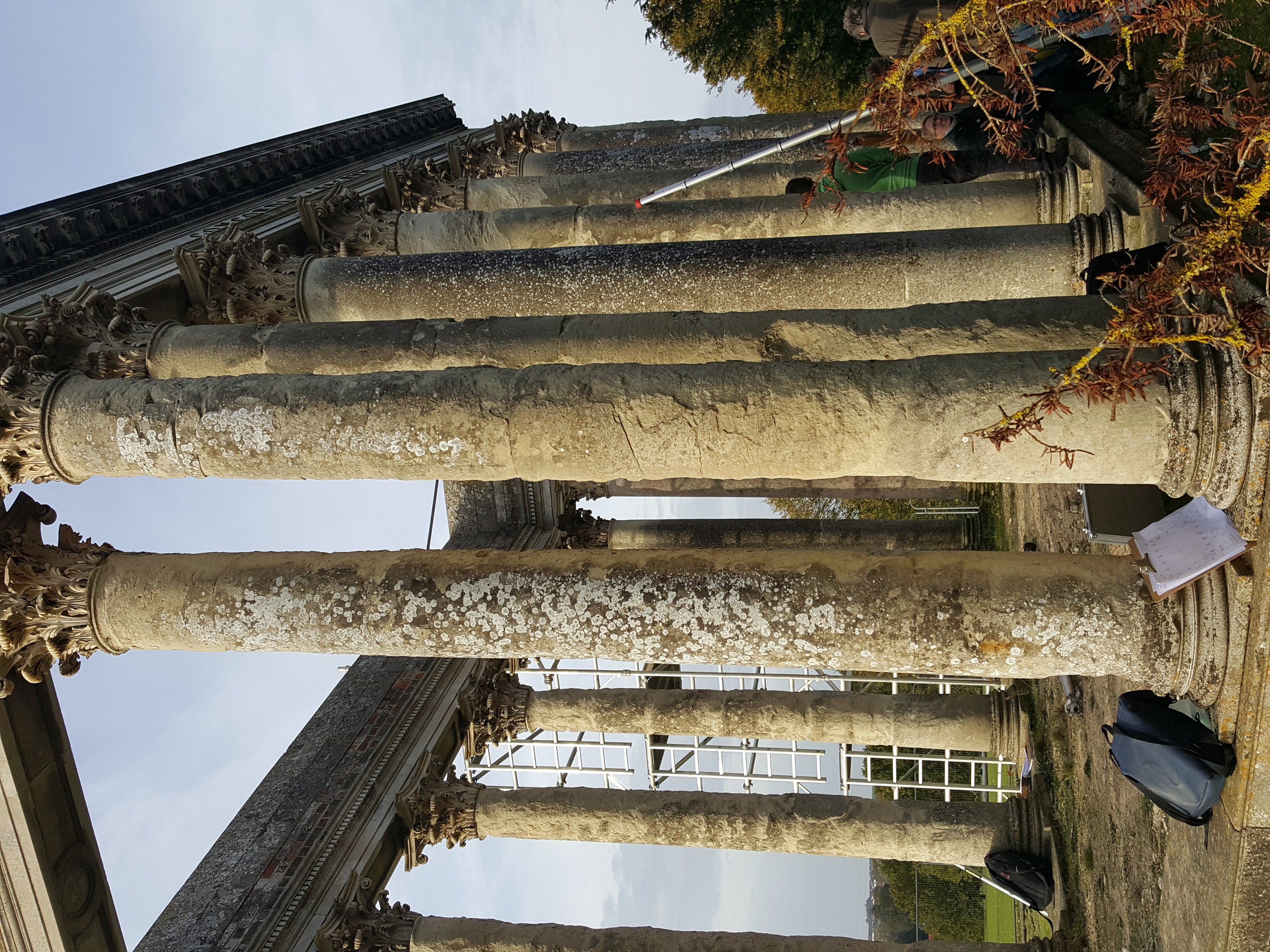
Research at Temple of Concord, Auderly End
JB: I’m particularly intrigued by the idea of a “vertical quarry” - a new way of thinking that looks at buildings as valuable material resources during and after their lifespan. I’ve heard you talk about pre-planning the volumetrics of stone (and other valuable materials) in a building with a view to being able to reextract them for future usage. Can you tell me a bit more about this approach?
LL: The construction industry is full of talk of BIM, and this technology seems to be gaining maturity at the design and build stage. The next logical stage is to look at end-of-life recovery and re-use, and this area seems to be where a lot of work is now heading. Recent developments in image capture, 3D scanning and computer modelling can be used to create a model. At the moment, research seems to concentrated on the structural frame, but there is no reason why this should not extend to the façade. For most of human history, we have reused building materials through pragmatism, and so this represents a move forward in strategic planning rather than a novel idea. With the ability to capture buildings in their pre-demolition stage, it is possible to establish the volume and nature of their components. Whether facades and internal fixtures are masonry or clad, either could be a potential source of marketable material for the future stone industry.
It is an absolute travesty for any viable material from a building to be crushed and used as low-grade fill when there is value to be gained by evaluating and curating what has already been extracted and dimensioned – often with considerable time and energy invested. This is what I mean by ‘vertical quarries’. Stone is easily identified, valued and recovered, which, with some limited further processing can be resold. In this way, buildings that are no longer of use can become urban resource repositories to support new builds. At the moment, recycling seems to focus on crushing en masse and re-binding at considerable energy expenditure. Minimising re-dimensioning reduces re-processing and digital protocols could be used to ensure costs are minimal.