

Surface Spot: Where textiles meet ceramic

Many surfaces are designed to look like other materials, not least with as digital printing technology continues to advance and improve. But it’s not often that a surface material will share almost all of the same visual qualities as something else. And yet, it’s not like there isn’t an appetite for it - just think about the enduring popularity of the Southbank Centre’s board-marked beton brut.
For Shifu Artisans, the tactile qualities of woven textiles provide the starting point for morphology™, where the textures and form of fabric are translated into ceramic to form permanent architectural finishes. The Asia-based design studio develops handcrafted tiles and vessels that bring texture, relief and material variation to interior surfaces. What’s more, they do so using ceramic content that is 50% recycled in its M2 and M3 collections.
The studio takes its name from the Chinese term 师傅 (Shifu), historically used to refer to master craftspeople, and its approach has material exploration at its core. Drawing on more than 25 years of experience across textiles, interior finishes and product design, founder Amy Saunders utilises hands-on research and prototyping to develop the collection. An interest in the relationship between craft, pattern and surface has led her to treat tiles as more than a background finish, with outcomes that play heavily with modularity, light and shadow.
The M2 Textile Texture Tiles establish the collection’s connection to textiles through six ceramic surface textures. Rather than applying a woven pattern as a decorative image, Saunders explores the underlying qualities of textile construction, including repetition, rhythm and tactility. These qualities are reinterpreted through the ceramic surface, giving the tiles a sense of texture and relief that can be experienced visually and by hand.
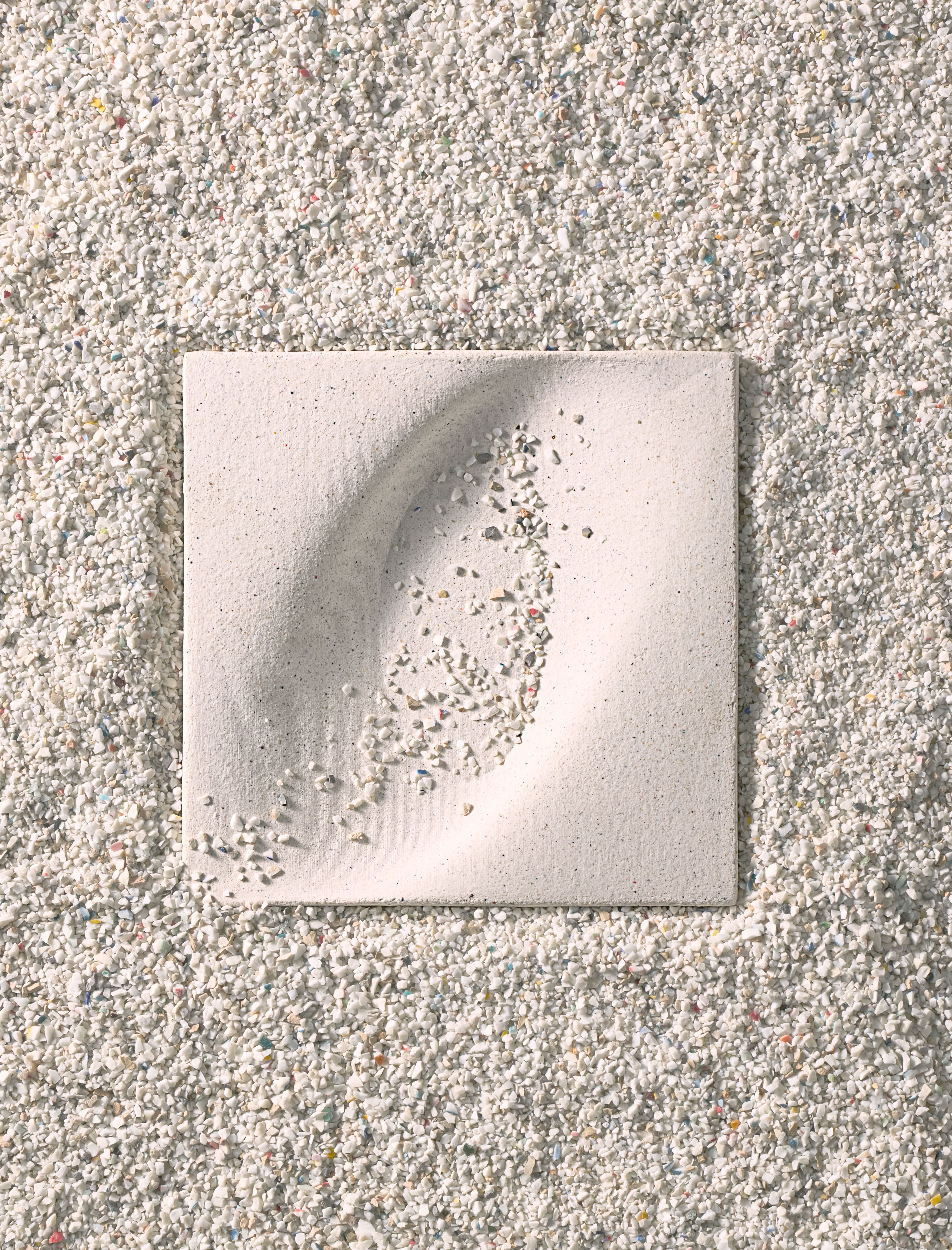
Alongside this, M3 Braid develops this approach into a more pronounced architectural surface. Its offset oval forms are both concave and convex, creating a three-dimensional relief that introduces depth and shadow. The individual components can be combined, reversed and reconfigured to produce different patterns and orientations, allowing the surface to change according to how the elements are arranged. The collection also extends into objects through M4, comprising the Ellipse vase and Sway cup series. These continue the exploration of offset oval forms and textile-derived textures at a smaller scale.
The recycled ceramic content is an important part of the collections, although it is an inherent given, rather than the sole focus. Instead, morphology™ explores how a material often treated in relatively conventional ways can be developed through changes in texture, geometry and production.