The entrance to Staffordshire’s National Memorial Arboretum has a new feature – a sculpture by local artist Graeme Mitcheson in granite from Tarmac’s Mountsorrel Quarry, near Loughborough, in Leicestershire.
There are several examples of Graeme's work at the National Memorial Arboretum as well as many other public sites across the UK.
The latest piece was added as part of the Arboretum’s contribution to The Queen’s Green Canopy – a tree planting initiative designed to honour the late monarch.
The nationwide initiative concluded in March. It saw more than 3million trees planted across the UK, including 28 along the entrance to the arboretum.
The 9-tonne block of granite includes 40 stainless steel elm, oak, and lime leaves, representing the trees planted in the arboretum’s contribution to The Queen’s Green Canopy.
As operators of Alrewas Quarry adjacent to the arboretum site, Tarmac has enjoyed a close relationship with the National Memorial Arboretum ever since it agreed to lease the land for the creation of the UK’s equivalent of America’s Arlington National Cemetery to commemorate the uniformed services for a ‘peppercorn rent’ in 1994.
The 150-acre site has since evolved into an inspirational landscape, home to more than 400 memorials dedicated to the armed forces, emergency services, and voluntary organisations that serve the country.
Philippa Rawlinson, director of the National Memorial Arboretum, says: “As our patron, Her Late Majesty Queen Elizabeth II was gracious and unwavering in her support for the arboretum over many years.
“It is wonderful that we were able to complete our contribution to The Queen’s Green Canopy at the arboretum on what would have been Queen Elizabeth II’s 97th birthday [21 April], as a celebration of her lifelong commitment to service.”
Nick Atkins, strategic planning manager (Central) for Tarmac, says: “We’re proud to continue our support for the National Memorial Arboretum and its ongoing work in nurturing a space which celebrates lives lived and commemorates lives lost.
“It is an honour to have been able to donate this piece of granite to mark the arboretum’s contribution to The Queen’s Green Canopy initiative.
“What a striking new addition to the arboretum! And a truly fitting tribute to Her Late Majesty Queen Elizabeth II.”
The entrance to Staffordshire’s National Memorial Arboretum has a new feature – a sculpture by local artist Graeme Mitcheson in granite from Tarmac’s Mountsorrel Quarry, near Loughborough, in Leicestershire.
SEO Title
National Memorial Arboretum gets a granite memorial for The Queen's Green Canopy
Hard on the heels of the Chelsea Flower Show, Welsh Slate and Breedon Special Aggregates are supplying celebrated garden designer Paul Hervey-Brookes with materials for his latest garden at the RHS Hampton Court Palace Flower Show, open 4-9 July.
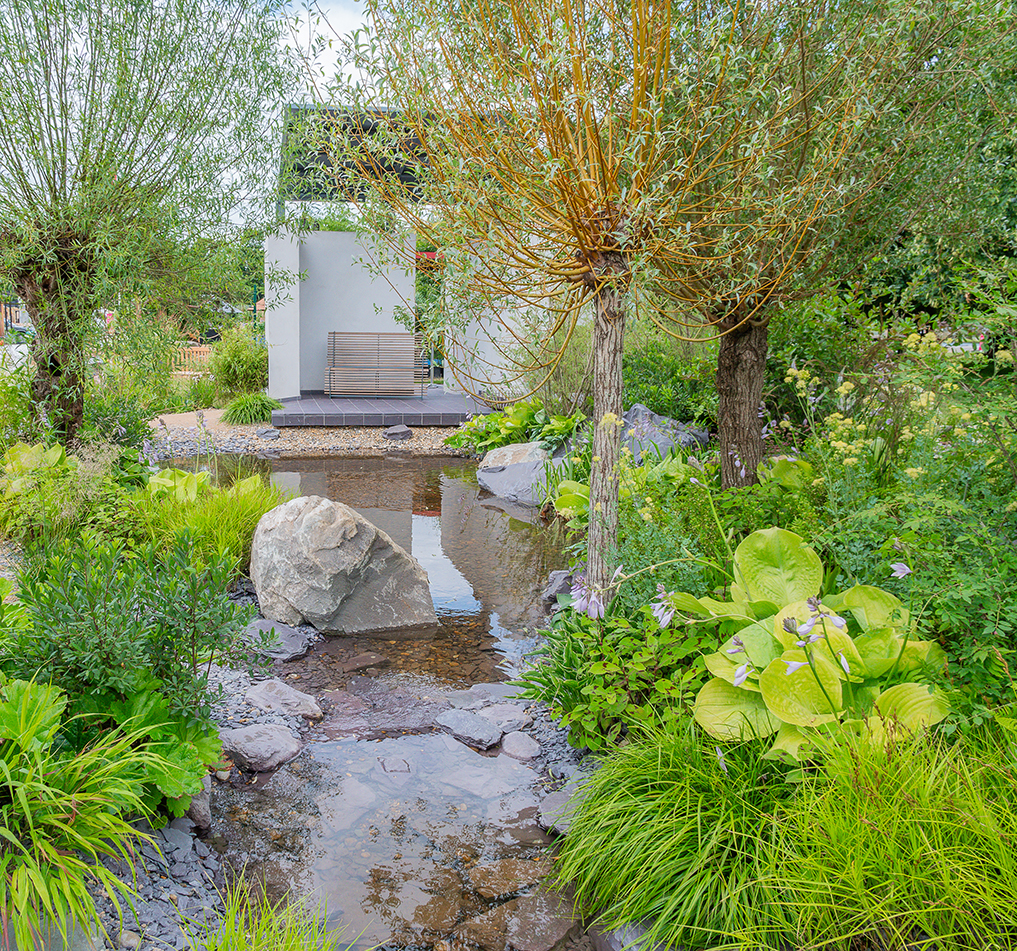
The Cancer Research UK Legacy garden has varying levels and is mostly hidden from the outside. Discovery happens when you step inside – stream inlets lead to a central body of water with an isolated jetty – a metaphor for the fear and loneliness cancer can bring – but facing the ‘Pledge Pavilion’, which symbolises hope and carries the message that, though the journey is difficult, it does not have to be made alone.
Welsh Slate and its parent company, Breedon, are supplying various landscaping materials to Paul’s Cancer Research UK Legacy garden at the show.
The garden reflects the hope and optimism brought about by gifts in wills, encouraging reflection, conversation, and connection in a tranquil woodland.
The Welsh Slate products are 15 boulders, 250mm x 500mm Penrhyn Riven paving, four glacial boulders, sliced glacial boulders, slate feature stones, rockery stone, and 40mm and 20mm Penrhyn Blue chippings.
From Breedon come 100mm concrete blocks from the group’s Wickwar site, various sized cobbles for the ‘river’ from the Wangford quarry, and Breedon Golden Amber self-binding gravel from Breedon quarry.
Paul’s garden at Hampton Court is being built by GK Wilson Landscapes, who also constructed his RBC Brewin Dolphin Garden at Chelsea Flower Show earlier this year.
Breedon is also supplying its Breedon Golden Amber self-binding gravel and MOT Type 1 sub-base to BBC Morning Live’s resident gardener, Mark Lane, who is creating the accessible RHS-BBC Morning Live garden at Hampton Court. This is being built by Augustine John Developments.
Welsh Slate and Breedon Special Aggregates are supplying celebrated garden designer Paul Hervey-Brookes with materials for his latest garden at the RHS Hampton Court Palace Flower Show
Paragraphs
SEO Title
Welsh Slate and parent Breedon at RHS Hampton Court Palace Flower Show
The next round of applications for up to £18,000 a time from the Queen Elizabeth Scholarship Trust (QEST) opens on 10 July. The money is to enable you to continue to develop your craft skills. You have until 14 August to apply.
Since it was created in 1990, QEST has awarded £5.5million to 800 individuals in more than 130 different crafts, including stonemasonry and stone carving. A directory of all those who have received scholarships can be seen on the QEST website (www.qest.org.uk) along with more details on how to apply.
In addition to QEST’s Scholarship and Apprenticeship funding, it has this summer launched an Emerging Maker Grant. This is to support talented early-career craftspeople through the launch of their businesses. Craftspeople that have set themselves up in business in the previous four years can apply for up to £10,000.
The funding specifically supports training and education, enabling you to enhance your craft skills and advance your career. The training can take many forms, from traditional college courses to vocational one-on-one training with a master craftsperson or a bespoke programme of short courses.
QEST is running three ‘How To’ sessions on Zoom to introduce those interested in applying for the grants to the different funding available, with tips and advice for filling in your application. There will be opportunities for a Q&As. The first on how to apply for a Scholarship is 12 July, 1-2pm. Click here to register.
On 18 July is a webinar on how to apply for an Apprenticeship. To register for that click here. And on 20 July is a presentation about how to apply for an Emerging Markers Grant – register here.
Italian surface specialist Santamargherita has launched Surfalite, a 7mm material in slabs of 3300 x 1650mm for wet wall applications.
This lightweight, low maintenance surface is said to be resistant to mould and mildew and, therefore, ideal for use in bathrooms and shower rooms.
Taking inspiration from natural stone, there are 16 designs spanning a monochrome spectrum, including Nero (black), Carnia (dark grey) and Vittoria White.
Santamargherita's Vice President of Sales, Michele Caneva, says: "We have been working on creating the surface of the future, and market research is showing that consumers prefer the look and feel of engineered stone slabs and porcelain for wet wall applications."
Now in its second year, the Stone & Vision Awards is a photography competition that aims to promote discussion about stone and terrazzo in the built environment. It is run by In Opera Group, which specialises in materials including natural stone and marble.
This competition invited architects, architecture students and interior designers to submit photos of built projects that depict stone or terrazzo in commercial spaces, public or private landscapes or private buildings.
The shortlisted images went on display at The Building Centre in Store Street, London, from Monday 26 June and will be there until 7 July. The winners were announced on Thursday 29 June. To see the winners and the shortlisted entries click here.
It might sound like the title of a science fiction novel but this is the cutting edge of the stone industry in the 21st century at Planet Granite near Coventry.
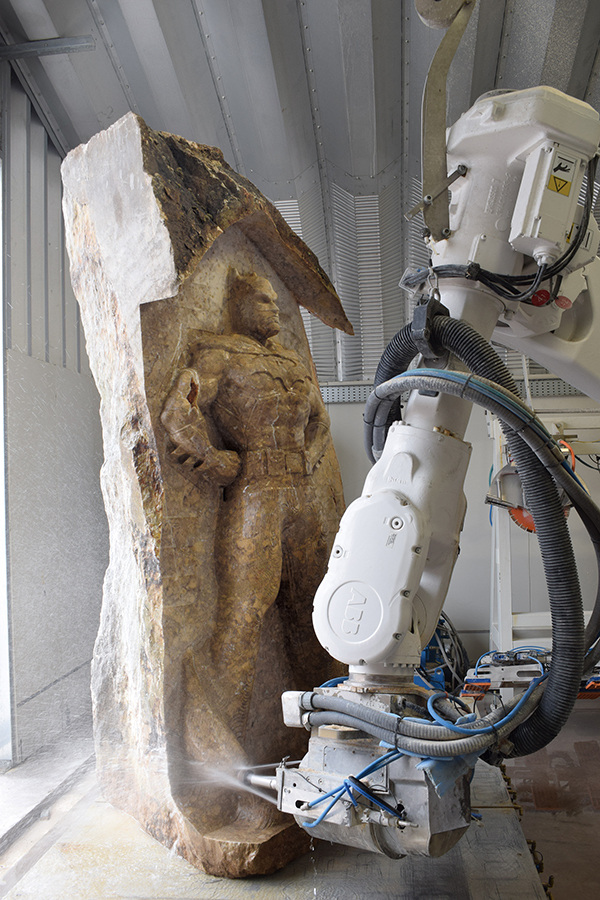
In a room that wouldn’t look out of place at the Kennedy Space Center, Steve Murphy, of Planet Granite and the new company Planet Sculpture, and his 17-year-old son, Stevie, look out of long windows on either side into workshops where three hefty ABB robots (that they have named Raphael, Michelangelo and Leonardo) are shaping stone.
The workshops that house the robots were put up by Steve and Stevie during the Covid restrictions. The control room houses the almost floor-to-ceiling supercomputers that run the robots and isolates the computers and the operators from the work areas.
Steve Murphy is impressed with the way his son has mastered the programs that run the robots – so impressed that he nominated him for an Emerging Talent Award at the Natural Stone Show, which took place at ExCeL London, 6-8 June. Stevie was one of the 10 winners of the Award.
Planet Granite exhibited at the exhibition to explain the capabilities of the robots. Terzago Robotics also exhibited at the Natural Stone Show.
Both Steve and Stevie went to Terzago in Italy for instruction on how to program the robots, although they have had to hone the process of putting it into practice by learning as they go in the Planet Granite workshops.
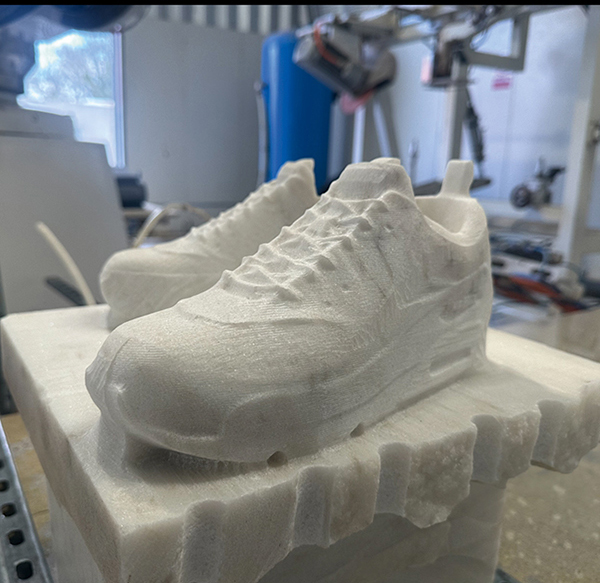
Niki trainers carved in marble by ‘Raphael’.
Stevie started studying engineering at the MTC college in Coventry after leaving school but found the pace pedestrian after what he had learnt at Planet Granite, so he has quit to work full time in the family business.
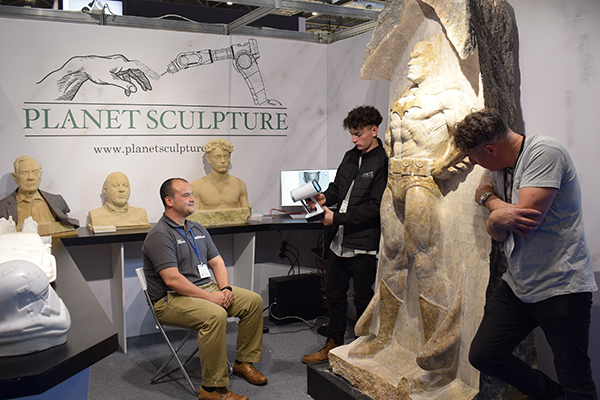
One of the first major stone projects they attempted was cutting the bigger than life-size Batman pictured above into a block of granite that had stood for years outside the Planet Granite showroom a few hundred metres from the workshops. A natural fissure in the stone has left Batman with a dramatic gaping wound in his arm.
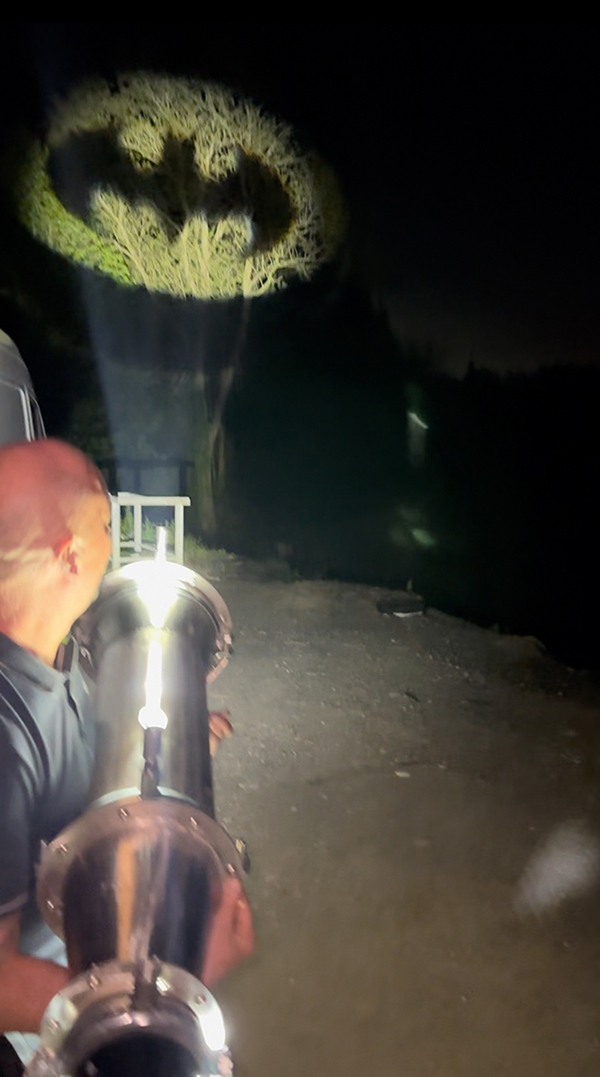
The finished sculpture was at the Natural Stone Show and afterwards was put back in front of Planet Granite’s new showroom. More drama has been added by a 100,000 lumin torch shining the Bat sign into the sky at night in the same way as the authorities of Gotham City call Batman when they need his help.
A 100,000 lumin torch that shines the Batman sign into the sky at night in the same way as the authorities of Gotham City call Batman when they need his help.
The robots previously belonged to J Rotherham in Yorkshire, which went into administration in 2020. The Administrator was going to be charged for storing the robots and was keen to avoid that expense. As a result, Planet Granite obtained four robots and all the tooling for significantly less than the tooling alone would have cost to buy new. The robots are now being operated as a separate company called Planet Sculpture.
Three of the robots are housed in the workshops either side of the control room, while the fourth is a saw jet on a 10m run – the same saw jet that had been shown at the MarmoMac exhibition in Verona, Italy, with a price tag of €1million. Named Scarlet after Steve’s daughter, it is housed in the workshop next door.
“Rotherham paid £4.7million for all this,” says Steve in his new workshops. “I saw the receipts.” In comparison, he considers the price he paid was a bargain.
Computer-controlled machinery needs to be programmed digitally and the most direct way of gathering digital data from existing objects is to scan them – as many worktop companies have discovered with wire or laser digital templaters.
Stevie scanning David Fisher, from the show organisers, at the Natural Stone Show in London watched by his dad, Steve Murphy.
Most of Planet Granite’s business is worktops – and it will continue to be because the robots come under a separate company called Planet Sculpture.
Customers of the robots will be different from those on the worktop side of the business, probably involving artists and designers looking for something made especially for them. To capture digital information for the robots, Steve has a high definition 3D scanner. They cost £35,000 each, but enable 3D scans of solid objects to be transferred to code so the robots can produce a sculpture of the object.
Steve admits there was a fairly steep two-year learning curve to program and use the robots and is grateful to Stevie, his son, for his contribution. “Once he had left college, within six weeks he had sorted everything out here, mostly teaching himself. He’s not a computer geek but he’s good at maths and was interested in physics at school. He ripped everything out and built the control centre. I had had two years of despair. I made mistake after mistake after mistake.”
Taking a punt
Steve admits buying the kit was a punt because although he has CNC machinery, including a waterjet, at Planet Granite, he did not know how to use robots and was not oblivious of the difficulties some people had found with them. “When I bought this kit everyone said I was mad,” he admits.
Initially he had put in a bid for just one of the robots. “I thought maybe I could handle that.” But the Administrator was keen to clear all the robots out to avoid the cost of storing them and accepted what Steve offered for the lot, including nearly £1million-worth of tools.
Steve did not know how he was going to use the robots but felt the technology was sufficiently advanced and interesting to give him an advantage.
Asked now what his customer base is going to be he is frank: “I have no idea.” Which is why he is exhibiting at the Natural Stone Show in London and has also employed a company to make 15-minute podcasts for him to promote the business.
But he is so impressed with what the robots can achieve he believes customers will emerge, on the basis of Ralph Waldo Emerson’s principle that if you build a better mousetrap the world will beat a path to your door to buy it.
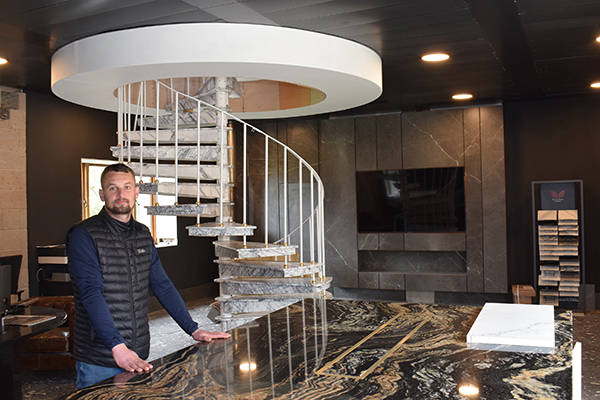
In the meantime, he has also been building a new showroom, with more examples of how stone can be used for interiors and a display he designed himself for showing whole slabs of materials to help customers visualise what their homes will look like with it, which is difficult with 50mm square samples. Planet Granite likes people to visit the showroom because when they do they generally become customers.
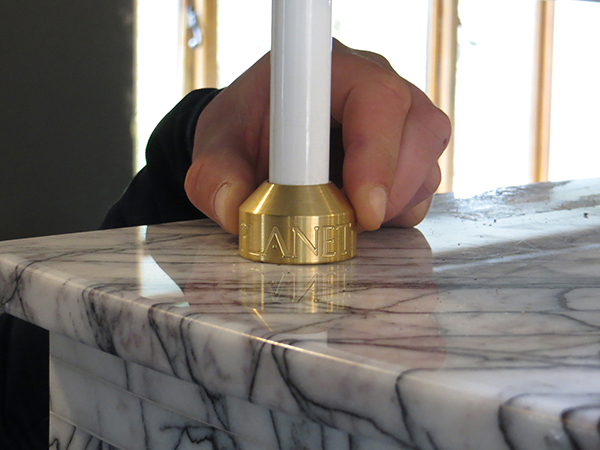
The showroom is on two floors, joined by a spiral staircase, which demonstrates another aspect of Planet Granite’s skills. And in one of many examples of attention to every detail, it has a banister that is connected to the steps using a fastener engraved with the name of Planet Granite.
Dan Paling, six years in kitchens and six months at Planet Granite, is in charge of sales in the new showroom, which includes a spiral staircase to more displays on the first floor. Full size slabs are displayed on units designed by Steve. Attention to detail extends to a Champagne cooler in the island and Planet Granite engraved fastenings on the banister.
Luke Conlon of Cotswold Natural Stone wants to elevate the status of the stone he sells and is doing so by re-branding and opening a one-acre stone centre with a Stone Gallery in Scrubbs Lane, Shilton in Oxfordshire, near the company's quarry.
The new logo of Cotswold Natural Stone.
The Natural Stone Gallery was opened with three days of celebrations on 20-22 June.
The site shows different styles of building stone and stone walling outside, with landscaping that uses stones from the quarry, including a bridge, and various sculptures by local artists, which are also for sale.
Inside the gallery there is stone flooring, fireplaces, and furniture, using Cotswold Natural Stone's and other British and European stones.
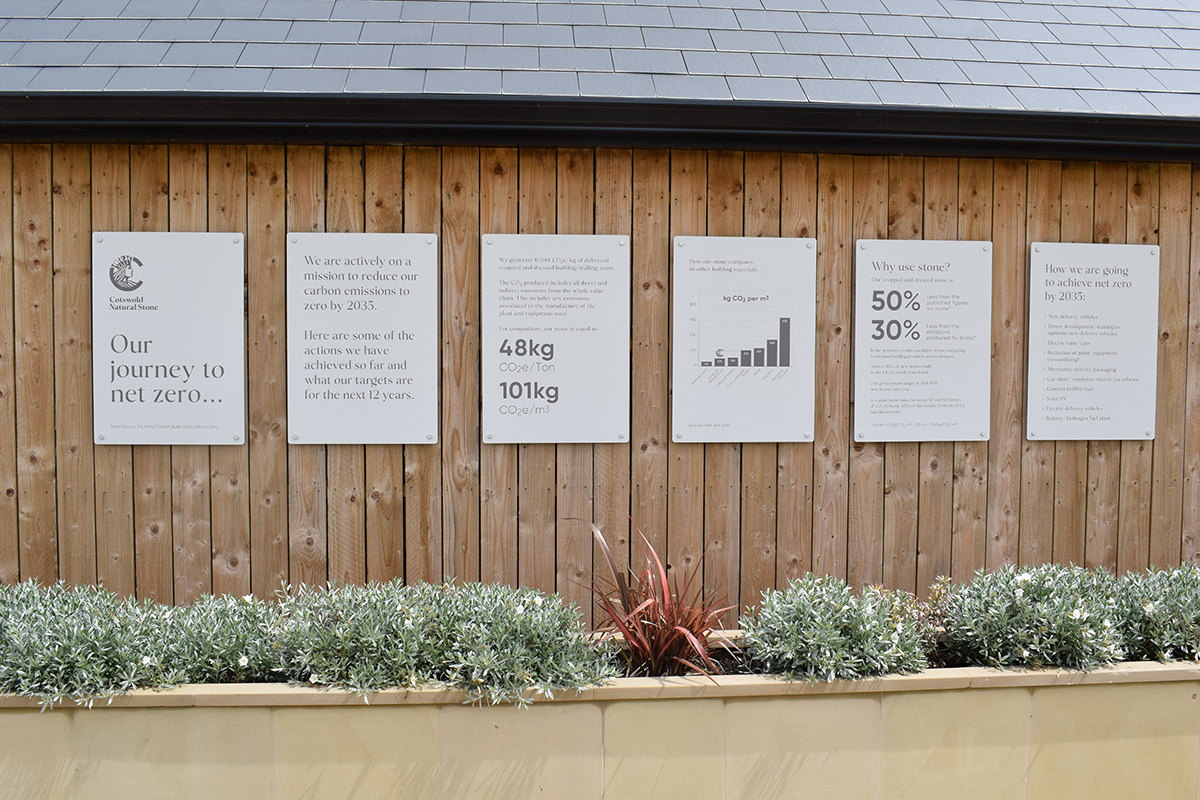
The low carbon footprint of natural stone is emphasised with a commitment to achieving Net Zero on the wall of the Gallery outside.
Cotswold Natural Stone's commitment to achieving Net Zero carbon emissions is written on the Gallery wall for all to see.
You can read the report on this high quality new stone centre and the plans of Cotswold Natural Stone published in Natural Stone Specialist magazine on the PDF below.
SEO Title
Cotswold Natural Stone re-brands, opens stunning new stone centre and heads for Net Zero
Amir Reske, who has been Managing Director of premium surface specialist Caesarstone in the UK since it opened its own warehouse in Britain in 2016, is leaving at the end of August.
Amir joined the company in 2016 (read his comments at that time here) and was responsible for establishing Caesarstone in the UK and Ireland, opening three distribution centres – in London, Manchester and Dublin.
He will now return to his native Israel to take on a new role.
Amir says: “Caesarstone gave me an opportunity to build a business from the ground up, set and implement the growth strategy, and promote it as a leading UK brand – and for that I will always be grateful. I have been privileged to work with a brilliant team, some of whom started with me at the very beginning and are still employed by Caesarstone, and I am very proud of the culture that we created within the organisation.”
His replacement is yet to be announced.
limittext
Off
Exclude From Lists
Include
Teaser Text
Premium worktop specialists, Caesarstone announce departure of Managing Director, Amir Reske
SEO Title
Amir Reske to step down as UK Managing Director of Caesarstone
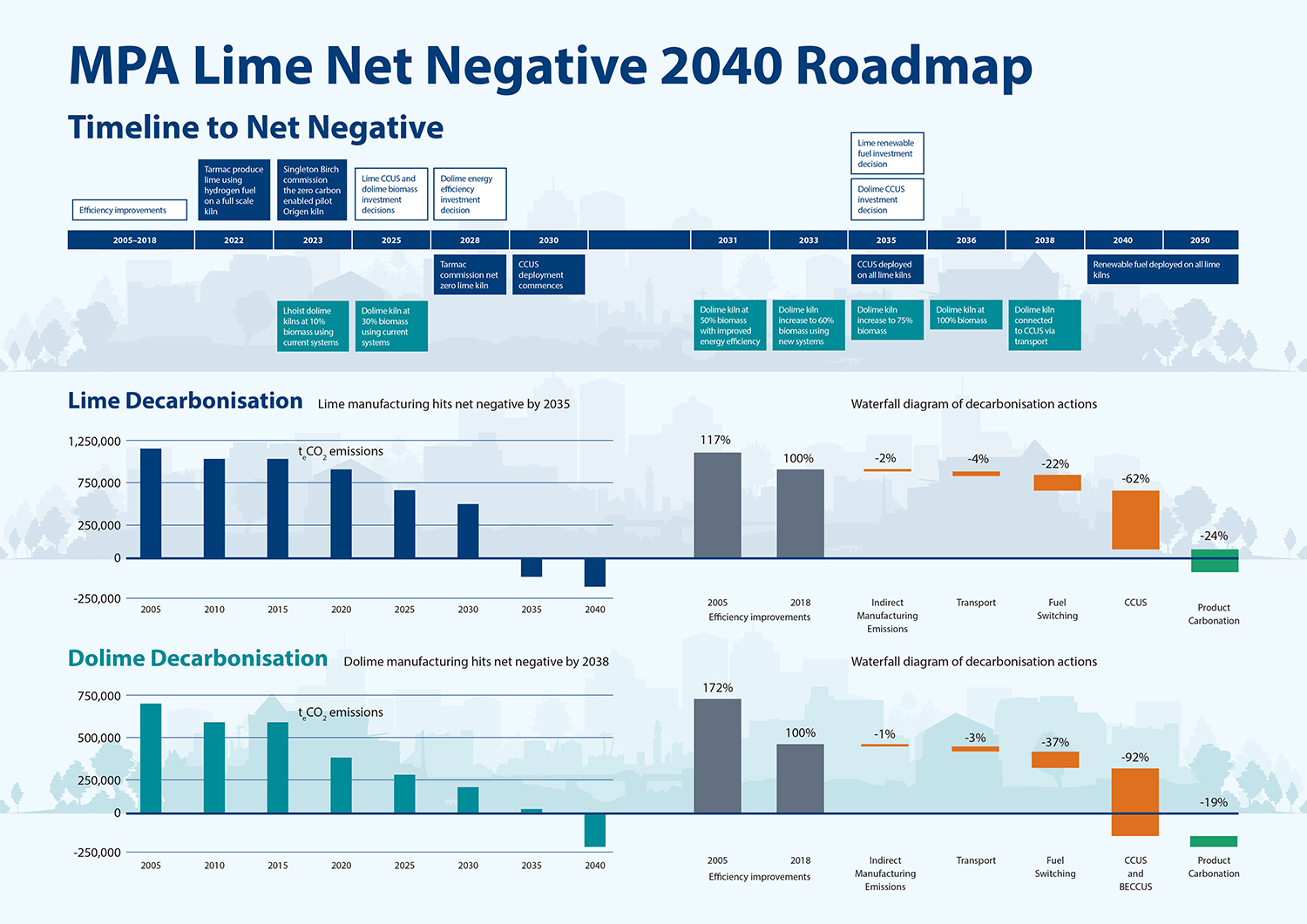
The Mineral Products Association's lime producers have launch an ambitious plan to deliver ‘Net Negative’ carbon emissions by 2040.
Spearheaded by the industry’s trade body, MPA Lime, the Net Negative 2040 Roadmap explains how the sector can go beyond Net Zero a decade ahead of the UK government's 2050 target by deploying technologies such as fuel switching and carbon capture, as well as employing lime’s natural carbon-absorbing properties.
The sector’s two main products – high-calcium quicklime and dolomitic lime (dolime) – are versatile and vital to numerous everyday essentials from the manufacture of metals, glass, plastics and building materials to the purification of drinking water, treatment of sewage, control of air pollution, animal welfare and production of many food staples including eggs, sugar, and dairy products. Lime mortars and putties are also produced.
Used around the world for millennia, lime is made by heating quarried limestone or chalk to above 900°C to trigger a chemical reaction known as calcination. Around two-thirds of the industry’s carbon dioxide emissions arise from calcination, with most of the remainder resulting from fuel combustion.
Since 2005, action and investment by British lime producers has already resulted in a reduction in absolute carbon emissions of around 25%. Now the industry’s Net Negative roadmap identifies further technologies and infrastructure to enable it to fully decarbonise, as well as outlining the enabling actions required by government and other industries in the supply chain.
In addition, research by the European Lime Association confirms that around one-third of the carbon dioxide from lime production is naturally re-absorbed from the atmosphere back into lime products – a process known as carbonation – although this has yet to be recognised in carbon accounting methodologies.
Combining the industry proposed developments with the enabling action by government and the natural effects of carbonation, means the production of British lime could become Net Negative by 2040 and make a positive and ongoing contribution to addressing climate change.
Richard Stansfield, chair of the MPA Lime management committee, says: "The British lime and dolime industry has already achieved remarkable progress in both business commitment and tangible actions to decarbonise and play its part in tackling climate change.
"The publication of our Net Negative 2040 Roadmap is a milestone on the journey and serves to communicate, as well as incentivise, the changes that are essential for the future. The pace of change must accelerate, and we are jointly committed to ensuring that it does. Importantly, we can’t achieve this alone. Reaching and exceeding net zero will also require some key enabling action by government and others."
MPA Lime Net Negative 2040 Roadmap: This ‘waterfall’ chart shows the contribution of each of the decarbonisation levers from historic baseline emissions in 2005 to a reference point in 2018, with each of the levers expressed as a percentage reduction of the 2018 reference. Some of the levers are happening now and are not yet accounted for (eg carbonation), some are relevant to early action (indirect emissions) and others cannot be deployed to their full potential right now due to the need for enabling action (fuel switching and CCUS). This is just one of the possible scenarios to deliver Net Zero production and a Net Negative outcome.
The MPA Lime Net Negative 2040 Roadmap shows how lime production could be decarbonised by 2040 through the deployment of five key levers:
Product carbonation – whereby exposure of lime products to the atmosphere can permanently absorb a third of the calcination-related carbon emissions
Fuel switching – away from fossil fuels to low- or zero-carbon alternatives like hydrogen or waste biomass could achieve a 22% carbon reduction for quicklime and 37% for dolime
Carbon capture, utilisation and storage (CCUS) – a fundamental requirement that will account for more than half of emissions from lime production
Reduction of the indirect emissions from electricity use
Reduction of emissions from transport of materials.
Mike Haynes, director of MPA Lime, says: "Each lever will contribute to decarbonisation – many initiatives are happening already or will come on stream this decade – and in combination they will deliver a dramatic carbon reduction to reach Zero by 2040.
"In addition, the combination of using biomass fuels with carbon capture and lime product carbonation will result in the removal of 250,000 tonnes of atmospheric carbon dioxide every year, making the sector net negative overall. Other levers, especially indirect emissions and transportation, require broader collaboration and enabling action by government and other industries."
Ruth Herbert, chief executive of The Carbon Capture & Storage Association, says: "It’s fantastic to see such a vital industry as lime setting out its own net-zero roadmap. The roadmap is clear that there is no option to decarbonise the lime industry without the installation of carbon capture, utilisation and storage (CCUS).
"It’s clear that demand for CCUS from UK industries is very high – with this roadmap alone planning for all five sites to access CCUS clusters by 2038. This reinforces our message to the Government that they need to urgently set out a national deployment plan for CCUS, indicating how and when sites like these can have access to CO2 infrastructure."
Examples of enabling action by government and other industries in the supply chain could include:
Carbon accounting to ensure that net zero is not met by simply closing British manufacturing sites and importing goods instead
Regulation that provides long-term visibility on decarbonisation policies and delivers cost-competitive clean electricity
Infrastructure that supplies green hydrogen to lime production sites and can transport captured carbon dioxide to storage or use
Financial support that attracts investment to UK sites for the deployment of decarbonisation technologies
Maintaining competitiveness to ensure British lime producers can continue to supply the UK and compete in international markets.
Mike Haynes: "Getting this enabling action right will allow the British lime industry to provide the whole of the UK, and beyond, with net-zero products that are essential to our everyday lives while removing more carbon dioxide from the atmosphere than it emits. The British lime industry is committed to addressing the challenges of climate change and we now have a credible roadmap to get us there."
SEO Title
Never mind Net Zero, lime producers aim for Net Negative
Earlier this year Italian adhesives and grouts company Mapei started launching carbon neutral tile fixing products on to the Italian market. Now those products are coming to the UK, starting with UltraColor Plus.
For Mapei, “zero impact on climate change” means that CO2 emissions measured throughout the life cycle of products from the Zero line – using Life Cycle Assessment (LCA) methodology, certified with environmental product declarations (EPD’s) – have been offset through the acquisition of certified carbon credits in support of renewable energy and forestry protection projects.
UltraColor Plus is Mapei’s signature anti-efflorescence, quick-setting and drying polymer-modified grout, featuring water-repellent DropEffect and mould-resistant BioBlock.
In the UK, zero-line adhesives will follow in the future.
Internationally, the product line includes Keraflex Easy S1 Zero, Keraflex Extra S1 Zero, Keraflex Maxi S1 Zero and Ultralite S1 Flex Zero adhesives as well as Ultracolor Plus grout.
Marco Squinzi, Mapei CEO, says: “At Mapei, the road to carbon neutrality is, first and foremost, through the optimisation of formulations to offer products with a smaller carbon footprint and, at the same time, high performance properties.
"Ten years’ ago we were the first to introduce the offsetting of CO2 emissions with the introduction of Keraflex Maxi S1 Zero, our best-selling cementitious adhesive for ceramic tiles. And, in 2022, thanks to the decision to also include our Ultracolor Plus among our offset products, we presented the first ever carbon-neutral system for installing ceramic tiles. Now, we are taking a further step by introducing an entire Zero line and we will carry on paving the way for the entire construction chain.”
Francesco Stronati, corporate product manager of the ceramic line, added “At this historic moment, where sustainability is no longer a choice but a necessity – as can be seen with the development of various environmental protocols for the classification of buildings – we want to bring our real contribution to the ceramic and construction sectors.”
Mapei’s commitment to 'corporate environmental sustainability' at its Corporate Research Centre in Milan means development is focused on the environmental sustainability of products and processes. The team measures the impacts of products on the environment throughout their life-cycle using Life Cycle Assessment (LCA) methods. The results are included on an Environmental Product Declaration (EPD). Currently, more than 80% of Mapei products are covered by EPDs.
The team works to create products with an increasingly lower impact on the environment by researching, right from the initial formulation phase, solutions to reduce consumption of raw materials and extend the use of recycled materials even further.
The team is also responsible for identifying carbon offsetting projects and other methods to mitigate the impact production processes have on the environment, while continuing to guarantee the quality and durability of products.