From the organisers of The Stone & Surfaces Show

  • Log in
  • Home
  • News
  • Jobs
  • Call for Submissions
  • Events
  • Advertise
  • Home
  • News
  • Jobs
  • Call for Submissions
  • Events
  • Advertise
Main Image
artwork_image_the_long_answers_of_water_light_and_rock_2026_marian_drew_video_installation_still._courtesy_of_the_artist.png

News: Stone-Focused Exhibition at No.1 Poultry

2026-01-21


Hypha Studios and art and architecture platform recessed.space have announced a new exhibition for early 2026 that puts stone, time and endurance firmly in the frame.


Hypha Studios

Hypha Studios


What Lasts Doesn’t Always Hold Shape forms part of Hypha Studios’ year-long programme at James Stirling’s landmark No.1 Poultry, which will presents a series of select shows engaging with architecture and the built environment in collaboration with recessed.space. 


Jobe Burns

Jobe Burns


At the heart of the project is the building itself and, in particular, the physical and symbolic life of the stone that wraps its distinctive façade. Curated by Taylor Hall and Rebecca Jak, the exhibition is set to bring together work by Marian Drew, Levent Ozruh and Jobe Burns.


Levent Ozruh

Levent Ozruh


Jak and Hall’s co-curatorial practice draws on their shared backgrounds in art and architectural culture and is rooted in reciprocity and knowledge-sharing across disciplines. They approach materiality as an act of empathy, viewing “the climate crisis through a cultural lens, and understand time as a tangible accumulation that settles within things, places and spaces.” 


The three artists will be responding directly to No.1 Poultry, a site built and rebuilt over nearly two millennia. The work will create a dialogue across these layered histories, using stone not simply as a material of endurance but as a witness to deep time and a register of “human fragility, intervention, ideology and cultural projection”. In this framing, stone’s capacity to endure is not treated as something guaranteed by the material alone, but as something sustained through ongoing negotiation, care and use.


What Lasts Doesn’t Always Hold Shape
Hypha Gallery 2, No.1 Poultry, London EC2R 8EN
29 January – 4 March 2026
Thurs–Sun, 1–6pm (and by appointment)
Private view: Thursday 29 January, 6–9pm

Reserve a free spot at the PV here!


Alongside the exhibition, the team are running a public program event, which will include Unpicking Architecture: the misuse and reuse of stone with The Stone Collective, a talk sponsored by the Stone & Surfaces Show. 

Get your ticket for the event here.


limittext
Off
Exclude From Lists
Include
Company Tags
M10
CAPTCHA
SEO Title
Stone and Endurance Explored in Hypha’s 2026 Show
Read more
Main Image
chinnery-_one_island_many_visions_2025.jpg

Surface Spot: Carving Conversations in Stone

2026-01-20


Since 2019, artist and academic Clair Chinnery has been making regular pilgrimages to the Isle of Portland to carve stone, working with the support of Hannah Sofaer and Paul Crabtree at the Portland Sculpture and Quarry Trust. For Chinnery, these trips are more than residencies; they are a return to an artistic moment she once sidestepped.


Back in 1990, as a 19-year-old first-year Fine Art undergraduate on a university field trip, she stood on Portland and refused to pick up a chisel, choosing instead to make assemblages from found materials at Church Ope Cove. Nearly three decades later, she returned to “make up for the lost carving opportunity”, and in doing so has developed a sculptural practice rooted in place, material and reflection. The fruits of this labour come in the form of beautiful, curved forms that she places under the title Conversations in Stone.


Working directly at the source of the stone has become central to how her forms emerge. Rather than imposing a fixed design, Chinnery allows the experience of carving Portland stone in situ to shape the outcome. She frames her approach as auto-ethnographic, using her own encounters with the island, its landscape and its industry as a lens through which to determine form.


Repeated visits to Portland have deepened her relationship with the material. Over time she has become fluent with traditional carving tools and processes, while also absorbing the wider context of the island: its quarrying heritage, fragile ecology and contemporary role in global mineral extraction. That layered understanding feeds directly into her making, giving the sculptures a quiet conceptual weight that goes beyond surface form.


These pieces are a reminder of how deeply material, place and process can intertwine – carved at the quarry face, informed by geology and industry, and shaped by a long-deferred artistic impulse.


limittext
Off
Exclude From Lists
Include
Company Tags
M10
CAPTCHA
SEO Title
Clair Chinnery’s Conversations in Stone on the Isle of Portland
Read more
Main Image
tmp_e2f2bf83-237e-4503-ac7d-573f8a15bc01.jpeg

News: Futurebuild and UK Construction Week Unite in 2026

2026-01-19


Futurebuild and UK Construction Week London are to join forces in 2026 in a move that will reshape the UK’s exhibition landscape and, organisers say, better mirror the way the construction industry actually works.


From 12–14 May 2026, the two shows will be co-located at Excel London, creating a new national platform for the built environment. Between them, they will bring together an audience of around 25,000 professionals, more than 600 exhibitors and some 700 speakers across 14 stages, making it the largest and most wide-ranging construction event in the UK calendar.


The ambition is scale, but not at the expense of identity. Both brands will keep their own curations, communities and content, while benefiting from the footfall and cross-pollination that comes with being under one roof. As Martin Hurn, Event Director at Futurebuild, puts it: “This is about creating one connected platform that reflects how the industry actually works – from vision to specification to delivery.”


Futurebuild will continue to anchor the sustainability, Net Zero and innovation agenda, with its CPD-accredited programme and its established audience of architects, designers, local authorities and developers. Low-carbon construction, circular materials and large-scale retrofit remain central, supported by The National Retrofit Conference, which has become a key forum for policymakers, housing providers and Net Zero leaders.


Alongside it, UK Construction Week London will stay focused on the practical realities of delivery. Its hands-on, solutions-led format brings contractors, housebuilders, trades and engineers into contact with the tools, systems and skills they need on site, backed up by live demonstrations, immersive features and CPD content rooted in real-world build challenges.


Hurn says the collaboration is about extending influence beyond theory and into practice. “Futurebuild will continue to lead on sustainability and long-term systems thinking, and collaborating with UK Construction Week London enables us to extend that influence into the practical, on-site world, turning ideas into real impact across the supply chain.”


For those in the materials and finishes world, there is a particularly strong hook. As we’ve reported, the Stone & Surfaces Show will also take place at Excel London alongside the two major shows, bringing a dedicated focus on natural stone, surfaces, finishes and materials. Its inclusion strengthens the event’s interiors and materials offer and opens up fresh opportunities for crossover between design, specification and installation – a sweet spot for anyone working with stone.


Sam Patel, Divisional Director at UK Construction Week London, sees that breadth as a strategic win. “UK Construction Week London has always championed scale, experience and solutions that matter to those delivering projects on the ground,” he says. “Collaborating with Futurebuild and The Stone & Surfaces Show unlocks new depth and strategic value, creating a destination that is richer, more relevant and more valuable to every part of the built environment.”


The timing is no accident. The industry is under pressure to decarbonise, modernise skills and meet increasingly ambitious Net Zero targets, and organisers say the co-location responds directly to calls for greater cohesion and clearer leadership. By combining Futurebuild’s sustainability leadership and systems-level thinking, UK Construction Week London’s delivery focus and The Stone & Surfaces Show’s specialist materials expertise, the new format promises a genuinely 360-degree experience – from big-picture vision through to specification, materials choice and on-site implementation.


For exhibitors, the commercial case is just as strong. Bringing specifiers, consultants and sustainability leaders into the same space as contractors, housebuilders and engineers creates a step change in opportunity. The benefits including: expanded reach and cross-sector visibility, longer dwell time, more connected visitor journeys and stronger alignment between specification, materials and delivery. There is also a clear focus on fast-growth markets such as retrofit, digital construction, offsite and sustainable materials.


“This is where the future of the built environment connects,” says Patel – a neat summary of what could become the industry’s most important annual meeting point.


limittext
Off
Exclude From Lists
Include
Company Tags
M10
CAPTCHA
SEO Title
Futurebuild and UK Construction Week Unite in 2026
Read more
Main Image
the_chancery_rosewood.jpg

Surface Perspectives: Tamsin Pickeral, Szerelmey

2026-01-19


Szerelmey is a historic UK specialist contractor specialising in stonework, restoration, conservation and new-build façade projects. Founded in 1855, the company comes with a time-served seal of approval, which is reflected in the numerous projects on display across the country. The team combines traditional craftsmanship with in-house design and delivery capabilities across complex architectural commissions, of which Operations Director Tamsin Pickeral plays a vital role.


What does a typical day look like for you?


Our offices are based in Vauxhall, London, and I come into the office three days a week. On those days, everything starts very early, with my alarm going off at 04:10! I sort my clothes out the night before to save a bit of time, chug a coffee, and start the day with some Radio 5 Live. I generally doze on the train and am at my desk by 08:00 with a pint of coffee. My days often involve meetings with clients, which I really enjoy, and also lots of internal team meetings. On any given day, I might be involved in project meetings, following up on sales leads and managing our compliance team, presenting CPDs, or talking at seminars on sustainability and material reuse. I can also be found visiting sites, management meetings, generating PR material, on a project photoshoot, running our CRM software or sitting in on Health and Safety meetings. I try to go for a very slow jog (more of a shuffle) at lunchtime to get some fresh air. 


My working from home days are a little less chaotic – to start with, I can have a lie-in to 06:15! Then I take my elderly greyhound for a walk before settling down with coffee and “getting stuff done”. I like to get all my work admin, planning and writing done at home, where it is nice and quiet and free from distractions…other than the dog.


How integral are materials/surfaces to your day-to-day? 


Materials are completely integral to my every day and are one of many reasons why I love doing what I do! Szerelmey is an interesting company because we have two distinct sides to the business – new build, which incorporates a lot of complex design works and a diverse range of materials, and restoration, which covers all types of restoration, remodelling, refurbishment, dismantling and rebuilding facades. We cover pretty much everything and everything, and it’s all material-focused. My role in terms of sales and marketing sees me delving around in our stone sample drawers on pretty much a daily basis, receiving samples from suppliers, sitting in on supplier presentations and talking to clients about potential materials. These can range from stone, brick, terracotta and faience, to mosaic, glazed basalt, glazed brick and stone brick – the list goes on. I find the range of materials we work with genuinely fascinating and get very excited (over excited) on occasion talking about them. The tactile nature of the materials really appeals to me, and nothing more so than being able to reuse or repurpose a material from one project to another, or even within the same project. One area of materials that I am really passionate about is faience. Faience is glazed terracotta and affords virtually limitless artistic potential. I spend quite a lot of time delivering CPDs on the use of faience in modern buildings and trying to convince architects to use it!


What are the biggest lessons you have taken forward from your original training? 


This is an interesting one for me because I fell into this industry by happy accident! My academic training was in History of Art and Architecture, which is entirely unhelpful for any career other than working in the arts, although I thoroughly enjoyed it. In hindsight, I think it did teach me how to look at buildings in a subjective and analytical way, which has helped me with my current role.  It also instilled an absolute passion in me for “good” architecture and for the significance of historic construction and materials. I spent twenty-odd years working as a freelance professional writer, mostly non-fiction books, websites and marketing material. This taught me resilience and how to sell, and it was through this work that I landed a contract writing a few pieces for Szerelmey. One thing led to another and all of sudden I was a full time employee with a job title. It has made me realise that it doesn’t matter where you start in your career; providing you are dedicated and prepared to put the work in, you will eventually get to where you want to be. I am also very lucky that the culture at Szerelmey allowed me to develop and learn – there is no better education than being surrounded by brilliant people, and I find I am still learning every day. I would say to anyone starting out in the industry or even thinking about it, just go for it. 


Which project/s are you most proud of being involved with and why?


This is a tough one because we are lucky enough to be involved with such amazing projects. One that definitely makes the cut is Battersea Power Station. Our Restoration team did all of the internal restoration work which also included a lot of structural steel works and making new openings etc. I was involved in this one very early on, which is often the case. I remember several site visits before any of the works began when the building was literally a derelict shell with no roof in parts. To see it now, and what the restoration of this hugely iconic building has done to regenerate the whole area is really quite extraordinary – I still have to pinch myself when I see it, and am so proud of not just our team but everyone who was involved in bringing this back to life, not least the developers with deep pockets behind it. 


Another of my favourite projects is a small faience-clad house called A House for Essex, designed by Fat Architecture and Grayson Perry. The building is quite extraordinary, somewhere between a Russian jewel box and Hansel and Gretal. The design tells the life story of an average girl from Essexbut in technical terms, the project was fairly complicated and completely clad in hand-produced and highly detailed faience units. The elliptical-shaped chimney, which is 2.5m tall, was particularly difficult to manufacture and install. One of the highlights of the project for me was taking Grayson to visit Darwen Terracotta for the day and the very lively conversations we had!


What do you feel are the main challenges facing the stone and surfaces industry today?


I would prefer to start with a positive. Due to the increasing emphasis on sustainability and carbon reduction, there are real opportunities for the industry at the moment, both in the use of locally sourced new stone and the reuse of existing materials. The reuse agenda is really interesting as it is making people think differently about how to do things and I believe we will continue to see massive steps forward in this respect, which is fantastic. That said, there are challenges, with economic uncertainty being key. Developers are understandably extremely cautious, and combined with a backlog caused by Gateway 2 problems, has led to significant delays in projects moving forward. Getting into contract is taking longer and longer and there are pressures to continually value-engineer elements. Another challenge that has become increasingly evident since Brexit is finding quality employees. I could go on, but I think it is important to remember that our industry is very resilient and there are exciting times ahead.


In your opinion, what are the positives of using stone in the built environment? 


Stone lasts pretty much forever, as evidenced by the volume of historic stone buildings and monuments, so if there is a genuine move towards sustainability, then a material with the longevity of stone must surely be the answer. A consideration is how we build. Modern building methods typically involve fixing slimmed down stone pieces to either steel or concrete, both of which have a significant carbon footprint. Traditionally, the stone was the structure! It is not feasible to build like this across the board today, but there are certainly strong cases for the use of structural and/or post-tensioned stone for some projects to reduce steel and concrete, as well as significantly reducing build time and cost. I am a huge supporter of using local materials where possible, too. There are tons of quarries of beautiful stone in the UK that have closed down, which is really sad. It would be great to see some government funding going into these, and the stone being used on local housing projects. Stone bricks in particular - they’re just like a clay brick but without the processing (firing), making them a fantastic low carbon alternative. 


How does sustainability shape your thinking and decision-making, and how do materials fit into this?


Sustainability is very much at the front and centre of every project I am involved with now, which is fantastic. However, there is still a huge amount of “greenwashing” going on; box ticking, misguided views on what is sustainable and what is not, confusion over EPDs (what do they actually mean and how to read them when they all appear to be set out differently) and cost. The most sustainable option for a project might not always be the cheapest, so it entirely depends on the client or developer, and to what extent they are prepared to build or refurbish in a sustainable manner. I really look forward to sustainability being genuinely embedded at the core of all building projects. We are not quite there yet, but I do think the industry is definitely moving in the right direction!


limittext
Off
Exclude From Lists
Include
Company Tags
M10
CAPTCHA
SEO Title
Tamsin Pickeral on Stone, Sustainability and Operations at Szerelmey
Read more
Main Image
can_architects_london_druid-grovecfelix-speller_low-res-2_1.jpg

Case Study: CAN Anchor a Residence With Stone

2026-01-15


Druid Grove is a modest London terrace that has been quietly but radically reimagined. Set on a residential street in East Dulwich, the three-bedroom house has been extended and refurbished by CAN for a visual artist client, transforming a familiar typology into something closer to a spatial artwork. The project demonstrates how material choices, construction processes and architectural narrative can work together to create a domestic environment that feels both experimental and deeply grounded, with a direct connection to nature.


Image Credit: Felix Speller

Image Credit: Felix Speller


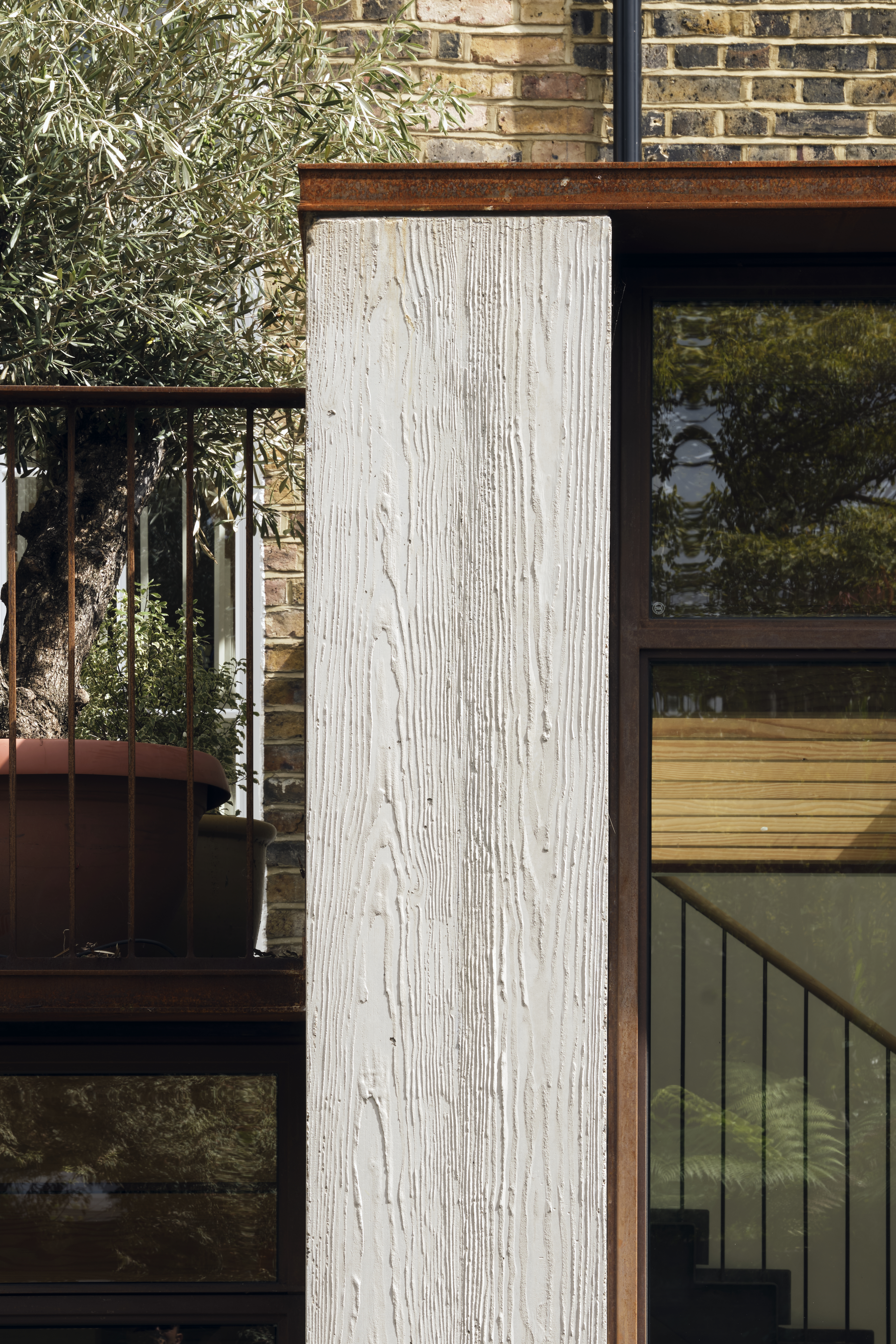
The most literal connection to nature sits just beyond the rear extension. In the garden stands a single upright stone, or menhir, acting as a privacy screen and symbolic anchor. Selected by the client and architect from a stone farm in Cornwall, the rock was craned delicately over the house into position. Geological history is embedded in the project here: the stone was last moved by glacial action some 15,000 years ago. Its presence introduces weight, age and a sense of protection, contrasting sharply with the lightweight steel canopy that shelters the patio.


Image Credit: Felix Speller

Image Credit: Felix Speller


The existing house was typical of its kind: compartmentalised, low on natural light and constrained by a narrow rear outrigger. CAN’s intervention has been relatively restrained in plan but ambitious in intent. A half-metre rear extension and the removal of a central loadbearing wall allowed the ground floor to be opened up and reorganised, creating a sequence of spaces that unfold gradually rather than reading as one continuous room. This spatial choreography became a framework for an intense exploration of materiality, texture and atmosphere.


The client’s brief was unconventional. Rather than precedent images of buildings or interiors, they shared references drawn from hyper-real natural scenes, industrial steel structures and florid, almost theatrical arrangements of flowers. For CAN, whose work often sits between architecture, art and cultural research, this provided fertile ground. Director and lead architect Mat Barnes describes the process as one of translating moods and mythologies into physical form, prioritising how spaces feel as much as how they function.


Image Credit: Felix Speller

Image Credit: Felix Speller


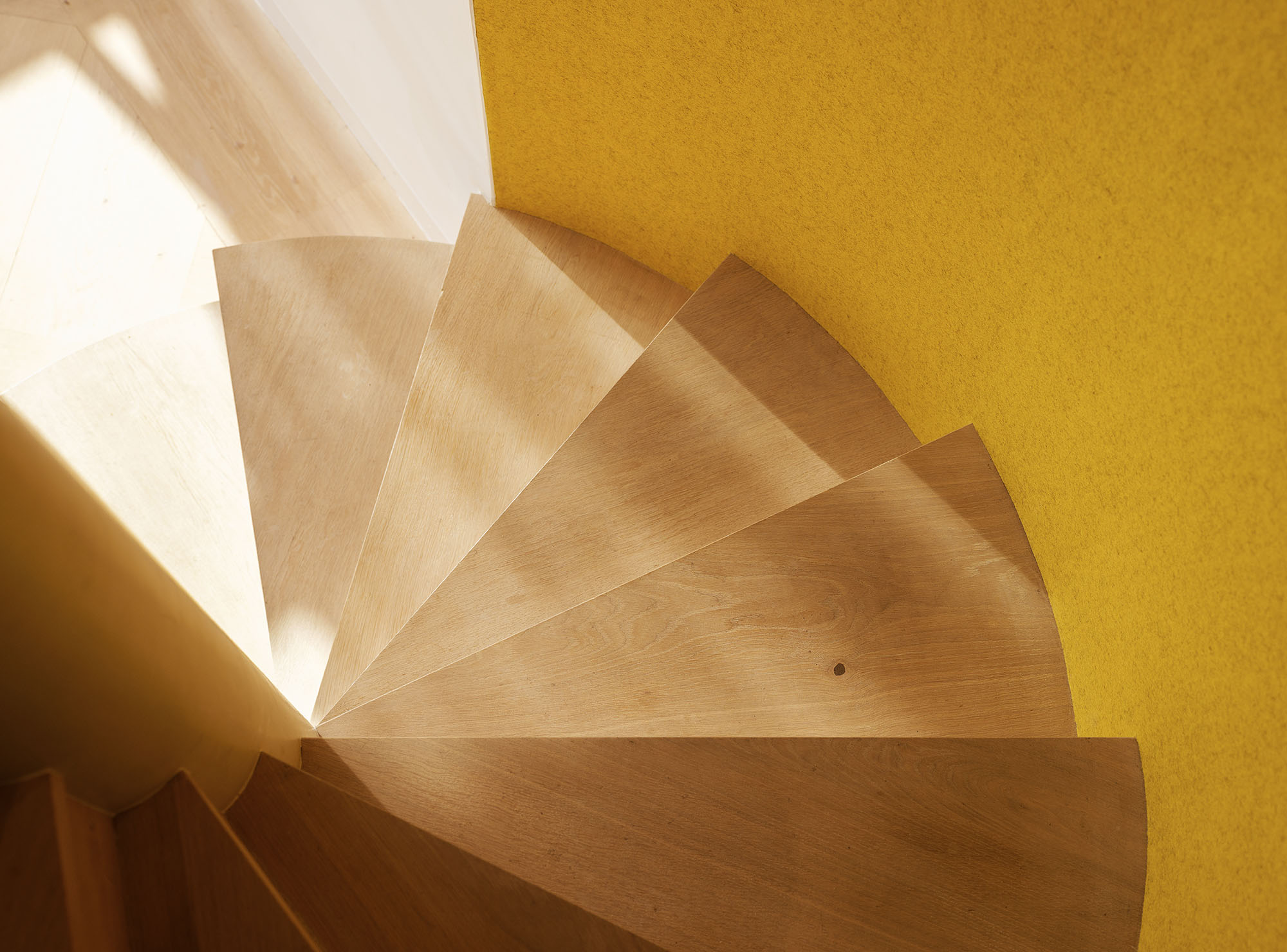
At the heart of the ground floor is an antechamber that was once a dark, underused dining area. Now it acts as a threshold space, anchoring the plan and introducing the project’s material language. A small bar is set into the room, while a pair of cave-like openings lead through to the living spaces on either side. These apertures are deliberately sculptural, concealing sliding pocket doors within their thickness and setting up a contrast between smooth painted surfaces and rougher textures beyond.


The front living room is deliberately restrained in palette. Walls and ceilings are finished in a creamy white that emphasises the geometry of the openings and allows light to move softly across the surfaces. Underfoot, Douglas fir plywood panels are oiled rather than lacquered, bringing out the grain and warmth of the timber and establishing a tactile, almost workshop-like quality that recurs throughout the house.


Image Credit: Felix Speller

Image Credit: Felix Speller


The kitchen and dining area is arguably where the project’s material experimentation becomes most pronounced. The space is organised around a four-metre-long stainless steel island that gently meanders through the room. Fabricated in two sections and craned in through the front window, the island incorporates integrated hobs and a fully welded sink, giving it the appearance of a single, monolithic object. Its reflective surface catches light and colour from the surrounding finishes, acting as both functional workspace and sculptural centrepiece.


Image Credit: Felix Speller

Image Credit: Felix Speller


Around this, CAN has combined bespoke elements with off-the-shelf systems. A tall pantry unit uses standard IKEA carcasses, but these are wrapped in Douglas fir plywood and finished with a burnt orange linseed oil stain. Above, timber trusses span the space, but are transformed into vegetal tendrils. Walls in the kitchen are finished in a grey rough-cast render, against which a panel of glazed Palet tiles in pink and orange tones provides a moment of colour and gloss. A high-sheen pale pink-cream paint elsewhere helps bounce daylight deep into the plan, reinforcing the sense that light itself is a material being actively shaped.


Image Credit: Felix Speller

Image Credit: Felix Speller


Throughout Druid Grove, CAN’s approach is consistent: materials are allowed to express themselves, construction processes are made visible, and domestic spaces are treated as sites of creative potential. Barnes notes that the challenge was to make the client’s futuristic and natural references “physical in a way that could be lived-in and grounded”. Stainless steel, ancient stone, timber, terrazzo and colour are brought together not for effect alone, but to create a home that feels protective, personal and wonderfully idiosyncratic.


The result is a house that resists easy categorisation. It is neither a neutral backdrop nor an overtly theatrical set. But for CAN, Druid Grove continues an ongoing exploration of how architecture can translate individual narratives into built form. 


limittext
Off
Exclude From Lists
Include
Company Tags
M10
CAPTCHA
SEO Title
Architects CAN transform a London Home
Read more
Main Image
img-20250130-wa0007.jpg

Surface Perspectives: Marcus Paine, Hutton Stone

2026-01-14


Hutton Stone is an independent, family-run quarrying and masonry business operating across the Scottish Borders and North Northumberland. Working with British sandstone from its own and other indigenous quarries, the company supplies material for restoration, new-build, landscape and bespoke projects nationwide. Recent highlights have also included supplying stone bricks for the Stone Demonstrator, along with an extension in Mile End. As Managing Director, Marcus Paine balances day-to-day production with a wider ambition: re-establishing indigenous natural stone as a credible, low-carbon material for contemporary construction. So what makes him tick?


What does a typical day look like for you?


These days, very varied. Of course, there’s the day-to-day management of the business in conjunction with the team. That might see me at our main production Yard at Hutton, or maybe at the Quarries, and in either case, supporting or adapting the direction we have collectively planned together. Increasingly in the last few years though, my time has also been taken up progressing the wider industry conversation on the future use of natural stone and what it can offer to a low-carbon construction solution. That might mean hosting one of a great number of tours of our facilities for students and architecture groups; attending seminars, giving talks and CPD’s, or collaborating with our other industry colleagues in showcasing exciting new ways to think about our material at national and international exhibitions.


How integral are materials/surfaces to your day-to-day? 


As 5th generation quarriers and suppliers of indigenous natural stone building products, our material, and engagement with it, are fundamentally critical to everything we do. Everything I do is mindful of both the potential and the limitations of each stone type we work, and communicating a deeper understanding of that to a growing audience interested in how we have come to think of natural Stone.


What are the biggest lessons you have taken forward from your original training? 


As far as my education in the natural stone trade is concerned, it has centered around the lessons learnt and passed down from several generations of my family, who physically worked the material in all its forms. This, together with my good fortune to set up my own stone career in the Scottish Borders and North Northumberland, which taught me a great deal about the significance of all the different areas of the country and how the material in any particular area differs from another. This became a real study for me as I sought to learn new techniques when I came North, and I came to understand just how incredibly significant the great quarries of the North had been in their heyday. My career before launching Hutton Stone Co Ltd was in associated construction trades and I worked for companies Large and small across London and the South of England. This taught me a great deal about working for different types of business, and different types of management approaches, and I have tried to be mindful of the view from my team’s shoes as best I can throughout my career. Beyond this, I was an unexceptional academic student, thinking myself cleverer and funnier than my teachers, which ultimately has led with the benefit of hindsight … to a hard life.


Which project/s are you most proud of being involved with and why?


Having started on my own in an old barn with an audience of bemused local builders who hereabouts had largely dismissed natural Stone as a forgotten luxury from a bygone age - in favour at that time of timber frame, block and render with a pebbledash finish - I can tell you that I am proud of every single stone I dressed (often in sheer desperation) in those early years. I am proud of all the staff that slowly but surely joined us as we developed and progressed, and I am delighted that many of those people are still my colleagues today.

We have completed projects including new builds , private dwellings, extensions, housing estates, hotels, office blocks, schools and hospitals. As well as restorations, such as castles, churches, stately homes, museums and civic buildings across the UK. It feels incredible to me now, and I am simply very proud to have been part of it.


What do you feel are the main challenges facing the stone and surfaces industry today?


I speak only for the natural stone industry -  which in all but a niche high end area of the market has been largely and very successfully eclipsed by other “surfaces” progressively throughout the 20 th century and now beyond. That is somewhat to do with social change and also an understandable outcome of our industrial development in steel, concrete, clay and glass through the harnessed power of fossil fuels. Our choice as an industry is either to continue to accept this outcome and be gone, or to begin reversing the trend by a very significant re-engaging with the wider design and construction industry on the cost effective, sustainable and many other merits of our material. The additional challenge for the indigenous stone industry everywhere is the battle that rages within itself from importation and substitution, along with a seeming acceptance that this is becoming the standard within the current construction model - regardless of true total cost.


In your opinion, what are the positives of using stone in the built environment? 


We are connected to natural products. It is true that we marvel at the imagination and ingenuity of the humanmade alternatives, with their glittering perfection, but people are inherently drawn to touch natural products such as stone and wood, and thereafter find natural variation a relief from the manmade alternatives. We all have to own our choices of course, but we see a growing movement of designers more moved by the natural imperfection and the benefits of embracing it.


How does sustainability shape your thinking and decision-making, and how do materials fit into this?


Sustainability and the question of how materials contribute to it have

allowed natural materials a chance to be reconsidered, and in the case of natural stone, a chance to reestablish itself as something more than an overly sanitised, thin, luxury dressing. Every choice we have made at Hutton Stone over the last several years has been entirely driven by this conversation, and to do our bit to ensure natural stone has a fair shout going forward in a currently reluctant status quo.


limittext
Off
Exclude From Lists
Include
Company Tags
M10
CAPTCHA
SEO Title
Marcus Paine of Hutton Stone on Natural Stone and Sustainable Construction
Read more
Main Image
screenshot_2025-12-16_at_15.11.5910728.png

Surface Spot: Fictional Ruins

2026-01-13


In Greek mythology, when Pandora opened Zeus’s box, she released irreversible evils upon the earth. The recent news cycle concerning the undressing of women by Elon Musk’s Grok is, for many, further proof that AI is our modern-day version of the box. 


Yet, as speculation about AI’s future impact continues to circulate at an adrenaline-inducing rate, there are clearly opportunities to utilise it as a practical tool, for good - particularly for creatives who are interested in the potential of text-to-image tools such as Midjourney.


Agata Murasko is a London-based architect and digital artist who creates spatial narratives that sit at the intersection of digital archaeology, visual storytelling and speculative design. In her work, the lines between fiction and reality are deliberately blurred.

In her recent self-initiated research project titled Fictional Ruins, Agata has been exploring the notion of architectural ‘ruin’ through the collective memory of A.I.  via Midjourney. Whenever prompted with a specific text, the software generates variants that conform to its own patterns, while also introducing some level of variation. 

By slowly excavating visual fragments of the data used to train the A.I. tool, emerging patterns began to suggest prevailing visual representations of architectural ‘ruins’ assembled from these shards. As she explains, Agata became interested in “the slight deviations from the patterns, or one might say errors and accidental anomalies,” which she has worked into her images, while utilising the tool as a collaborator.


By blending traditional methods and A.I., Agata develops imaginary that is evocative, poetic, and at times uncanny. Her images represent spatial sequences where ancient structures anchor contemporary spaces, blurring the boundary between real and surreal. Through these speculative narratives, she aims to invite audiences to reimagine architectural ruins not as remnants, but as sites of possibility. And perhaps unsurprisingly, given its ability to endure over time, stone is consistently and prominently the material of choice to do so. 

Drawing inspiration from literature, observations, and her experience as an architect working on building reuse projects, Agata is challenging this novel technology and the assumptions we may be making about it. She hopes that her images can “enhance our conceptual thinking and what value as creatives we bring in the context of the emerging A.I. technologies.” Hope is, after all, the one thing Pandora managed to leave in the box.


limittext
Off
Exclude From Lists
Include
Company Tags
M10
CAPTCHA
SEO Title
How Architect Agata Murasko Uses AI to Reimagine Architectural Ruins
Read more
Main Image
wff_wet_blade.jpg

News: WFF Unveils Industry-First Quality Mark for Safer Worktop Fabrication

2026-01-12


The Worktop Fabrication Federation (WFF) has launched what it describes as a first-of-its-kind quality mark aimed at helping specifiers, retailers, designers and consumers identify kitchen worktops that have been fabricated without putting workers’ health at risk.


As we’ve reported, the scheme comes against a backdrop of growing concern over silicosis linked to poor control of respirable crystalline silica (RCS) in fabrication workshops. By introducing an independently assessed mark, WFF says it wants to clearly differentiate responsible businesses from those “willing to risk having a beautiful kitchen at the cost of someone’s health or life”.


At the heart of the quality mark are regular, independent workplace assessments carried out by professionally registered occupational hygienists. These assessments focus on the recognition, evaluation and control of health hazards, particularly those associated with high-silica materials. Kevin Bampton, chief executive of the British Occupational Hygiene Society (BOHS), said the intention is to give the supply chain “a clear choice”. “Buying a worktop from an accredited company means you are buying from a business able and willing to protect a worker’s health,” he said. “Buying elsewhere means you are willing to risk having a beautiful kitchen at the cost of someone’s health or life.”


Accredited fabricators will also actively promote the Lungs at Work project, providing a direct referral route for workers who may previously have been over-exposed to silica to access medical screening. In line with emerging clinical recommendations, participating businesses must commit to enhanced health surveillance to support earlier detection of respiratory risk.


While engineered stone is a key focus, the WFF stresses that the quality mark applies to all high-silica materials that can pose a health hazard if not properly controlled. The scheme allows retailers and the wider construction supply chain to verify whether products have been fabricated in environments that comply with recognised good control practice. Accreditation status will be publicly displayed and easily checked via the WFF website.


Fabricators seeking the mark must demonstrate robust management systems, effective exposure controls, comprehensive training, and safe storage and handling of materials. The criteria align with guidance from the Health and Safety Executive (HSE) and BOHS, with BOHS specialists continuing to review and strengthen the requirements.


BOHS has worked alongside WFF to develop training and research that tackles real-world barriers to effective control. Dr Johanna Feary FRCP, PhD, highlighted why this approach matters. “Silicosis is a preventable but irreversible lung disease, and we are seeing increasing numbers of cases linked to poorly controlled exposure,” she said. “An initiative such as this kitemark… is a significant step forward in protecting workers’ respiratory health.”


She added that focusing on education, effective exposure control, avoidance of high-silica products where possible and early health surveillance “has the potential not only to reduce future disease, but to identify people at risk earlier, when interventions can still make a meaningful difference”.


Dr Scott McGibbon, director at Pvotal Consultancy, described the requirement for independent occupational hygiene assessments as a landmark for British manufacturing: “The WFF partnership with BOHS, underpinned by the new quality mark, signals a strong commitment to raising occupational hygiene standards and providing trusted, independently verified assurance of workplace health practices.”


The quality mark signifies a positive start to 2026 for the industry, with WFF positioning it as a practical tool to improve confidence, compliance and, ultimately, worker health across the worktop fabrication sector.


limittext
Off
Exclude From Lists
Include
Company Tags
M10
CAPTCHA
SEO Title
Worktop Fabrication Just Got a Little Safer Thanks to WFF
Read more
Main Image
dsc00516.jpg

Surface Perspectives: Blair Woodland, Woodland Stonework

2026-01-09


Nestled between the breathtaking north Cornish coast and the rugged Bodmin Moor, Woodland Stonework builds mortared walls, drystone walls, stone cladding for new builds, Cornish hedging, and bespoke commissioned pieces. The man behind the company, Blair Woodland, has a passion for stone craft, which is apparent from the many varied projects in their extensive portfolio. So what makes a traditional craftsperson like Blair tick? 


What does a typical day look like for you?


There’s rarely such a thing as a standard day on site. Larger jobs can stay the same for a while, but because I work across so many areas of stonemasonry, no two projects are ever truly alike. That variety is the beauty of the job. It keeps you thinking, learning, and passionate.


Last winter was spent on a single project. Two large, sweeping Cornish hedges flanking a new driveway. The work involved cutting trenches into compacted farm track, placing heavy slate boulders into the footings, sifting through over 100 tonnes of stone, and shovelling nearly 50 tonnes of soil into the centre of the walls for compaction. This winter couldn’t be more different. I’m now working at a grand Georgian manor house, one of the most picturesque settings I’ve worked in. The project is a bespoke granite and slate sphere for the garden. This will be the centerpiece outside the newly built orangery.  While I love all aspects of stonemasonry, jobs like this are the ones where you really invest yourself fully and really push your craft for perfection.


How integral are materials to your day-to-day?  


Materials are the most integral part of my work. Without stone, and the right stone, I simply don’t exist. Every job revolves around it, and each project demands something different. Stone is never just a material,  it defines the finished work.


Some work involves repair or conservation, where matching existing stonework is essential. That means finding not just the right type of stone, but the right colour, size, and character. People often assume slate is slate or granite is granite, but in Cornwall that couldn’t be further from the truth. I have five slate quarries near where I live, all within a few miles of each other, yet each produces a distinctly different slate.


Because my day-to-day job is laying stone, there’s never a moment when I’m not handling it or thinking about it. Over time, you develop an instinctive understanding of how a stone behaves. Whether it’s soft or hard, how it reacts to a hammer or chisel, whether it needs a gentle touch or a firmer hand. That knowledge becomes second nature. You don’t stop to overthink, your eye reads the wall, your hand selects the stone, and a few taps later, it fits snugly into place. It’s instinct.


What are the biggest lessons you have taken forward from your original training? 


I don’t have any formal training in stonemasonry, and if I’m honest, it was never something I planned to do. I vividly remember telling my parents as a child, “I don’t want to be a builder like Dad,” purely because I didn’t want to get up early for work, which probably explains why I still try to ignore my alarm clock.


I set out to become a fine-dining chef and did exactly that, working as a pastry chef in two high-end restaurants. But around fifteen years ago, I fell out of love with the industry. I ended up doing the very thing I’d sworn I never would, working alongside my dad in building. 


He’s a skilled stonemason and a real lover of the craft, so there were plenty of jobs where I laboured while he worked the stone. That’s where my real education began. Whenever I wasn’t mixing mortar or shifting stone, I was watching, learning, and absorbing. Stonework immediately caught my attention; it was creative, physical, and permanent, something that would stand for generations.


I started trying to anticipate which stones my dad would need next and handed them to him, quietly proud of my choices, even if he never used them. Over time, I was trusted to lay a few stones myself, then whole sections, and eventually an entire wall on my own. From there, the work grew until I found myself responsible for all the stonework on a multi-million-pound new build. After that, the decision was clear. Stonework was what I wanted to do. From then on, I focused solely on the craft. Studying different styles, techniques, and materials wherever I could and learning by doing.


Which project/s are you most proud of being involved with and why?


One of the most meaningful projects I’ve ever worked on was helping my dad rebuild a listed threshing barn.


The brief was uncompromising. The barn had to be rebuilt using traditional materials and methods throughout. That meant constructing two-foot-wide solid stone walls with the original stone, laid in lime putty, just as they would have been two centuries ago. 


Having the opportunity to build something in this way was extraordinary. I’ve worked with lime before, but this was different. We weren’t repairing or adapting an old structure, we were rebuilding a 200-year-old barn from the ground up. 


Projects like that are incredibly rare now, largely because modern materials and methods have replaced traditional building practices. To be trusted with work of that importance and to experience firsthand how buildings were once constructed to last for generations was something special. It’s the kind of job I doubt I’ll ever have the chance to do again, and one that has stayed with me ever since.


What do you feel are the main challenges facing the stone and surfaces industry today?


There is one issue above all others that I believe is doing real damage to my trade. Stonework is being carried out by people with no training, no understanding of the material, and no passion for the craft. It’s driven largely by the demand for work to be done as quickly and cheaply as possible, and in my view, it’s slowly eroding the foundations of stonemasonry.


I see it almost daily; walls built using incorrect techniques, poorly proportioned, structurally unsound, and visually disappointing. More often than not, jobs I price end up going to the cheapest quote. I then drive past once the work is finished and see the result, stonework that simply doesn’t work, either practically or aesthetically. It’s frustrating, especially when there is so much stonework being done, yet so little of it being laid by knowledgeable stonemasons. If this continues, this ancient craft risks being lost altogether, which would be a real shame.


There are also far fewer working quarries now than there once were. Historically, most estates, manor houses, and even farms had their own small quarries, drawing material directly from the land. Today, sourcing stone takes far more care, knowledge, and attention.


In your opinion, what are the positives of using stone in the built environment?  


Using stone in the built environment is deeply important to me. It is about holding on to our heritage. England has been built with stone from the very beginning. Our greatest and most beautiful buildings are made of it, and they stand as proof of what was achieved in architecture and engineering long before modern materials took over. From Bath Abbey and York Minster to Rievaulx Abbey, Hadrian’s Wall, and the Roman Baths, the list is endless. From great cathedrals to simple clapper bridges on the moors, stone runs through the fabric of the country. Stone is England, and England is stone.


While I am not building cathedrals or churches, I believe the work I do as a stonemason still matters. I am proud to play my part in keeping the craft alive. Without passionate stonemasons carrying this tradition forward, we risk ending up in a truly concrete jungle, with the closest substitute for stone being a painted tile made to imitate it.


How does sustainability influence your decision-making?


Because stone is always my primary material, the question of sustainability is fairly straightforward. Stone is the epitome of sustainability; it’s a natural product gifted by the earth. As it does need to be quarried and transported, that impact must be considered, but any human-made material requires far more processing, energy, and resources than stone ever will. For that reason, it remains the best option in my book.


There are, however, key considerations I always take into account when working with it. Location is one of the most important. I aim to source stone as close as possible to where it will be used, which reduces transport distances and ensures the finished work sits naturally within its surroundings. There’s little point in building a wall from dark, heavy slate in an area where the local stone is a lighter brown slate; it simply won’t belong.


The quality of the quarry is equally crucial. Choosing the right source ensures a consistent, reliable material, which reduces waste, unnecessary transport, and the removal of rejected stone. High-quality stone also allows you to produce high-quality work - something that shows not just on the day it’s built, but decades into the future. And if it does fail, it can be repaired using more stone rather than replaced entirely.


limittext
Off
Exclude From Lists
Include
Company Tags
M10
CAPTCHA
SEO Title
Discover what life’s like for a Cornish stonemason
Read more
Main Image
web_-_geocrab_-_external_01_-_c_richard_gaston.jpg

Case Study: Caochan na Creige

2026-01-07


Built almost entirely from locally quarried Lewisian Gneiss, Caochan na Creige rises directly from the rocky outcrop on which it sits, overlooking the Minch towards Skye. Here, stone is not applied as cladding or surface treatment; it is the defining fabric of the building.


The remote, self-built stone house on the Isle of Harris has been designed and built by Edinburgh-based practice Izat Arundell, and was named RIBA House of the Year 2025 just before the festive break. An early Christmas present perhaps, but this project has been a labour of love that’s been years in the making.


The house is the first new-build home on Harris for the practice, and also the private residence of the its founders, Eilidh Izat and Jack Arundell. Alongside their architecture studio, the couple also run the Edinburgh-based holiday let Porteous Studio and Scottish cider company Linn, but this project represents a particularly personal undertaking, and one fraught with obstacles. The house was entirely self-built by Jack Arundell, along with Eilidh’s brother, Alasdair Izat, a furniture maker, and their friend Dan Macaulay, a stonemason. Construction began in January 2022 and took 18 months to complete, during which the team endured nine named storms, working through some of the most challenging conditions the Hebrides can offer.


Placing vernacular stone construction firmly at the centre of contemporary architectural discourse, the project is notable not only for its architectural acclaim but also for the way stone is used as both structure and narrative. The Lewisian Gneiss used for the walls was sourced from a quarry less than five miles from the site, ensuring geological continuity between building and ground. Coupled with the team's tangible connection to the site and the building brings a sense of belonging.


The house’s form is deliberately sculptural, shaped to respond to both the extreme climate and the expansive views. Perched above sea level, it is oriented to capture panoramic vistas while offering shelter from Atlantic winds. This balance of exposure and protection is a recurring theme in island architecture, and one Izat Arundell reinterprets through carefully angled walls and openings. Stonework is robust yet precise, with careful attention paid to coursing, junctions and openings. 


The stone’s varied colour and texture give the elevations a geological depth that changes constantly with Hebridean light and weather. A concrete parapet with exposed Lewisian Gneiss aggregate caps the walls, subtly echoing the masonry below while introducing a crisp contemporary line at roof level. Hardwood windows are deeply set within the stone, reinforcing the thickness and solidity of the walls. The result is a building that feels crafted rather than assembled, reinforcing the idea that contemporary architecture and traditional stone skills are not mutually exclusive.


Inside, the influence of Harris’s vernacular black houses is apparent. Rather than rigid rectilinear rooms, the plan is defined by soft angles that guide movement through the house. Spaces flow into one another while remaining distinct, creating a sequence that feels both intimate and expansive. Black houses aren’t orthogonal, instead shaped by hand, by weather, and by use, and that softness shines through via modern construction methods.


Caochan na Creige offers a powerful reminder of what locally sourced stone, skilled craftsmanship and architectural ambition can achieve together. Its recognition as RIBA House of the Year 2025 not only celebrates Izat Arundell’s work, but also elevates stone construction as a sustainable, expressive and future-facing building method.


Image Credits: Richard Gaston & Jack Arundell


limittext
Off
Exclude From Lists
Include
Company Tags
M10
CAPTCHA
SEO Title
A Stone Home Wins RIBA House of the Year
Read more

Pagination

  • First page « First
  • Previous page ‹ Previous
  • …
  • Page 5
  • Page 6
  • Page 7
  • Page 8
  • Current page 9
  • Page 10
  • Page 11
  • Page 12
  • Page 13
  • …
  • Next page Next ›
  • Last page Last »
Subscribe to
  • Advertise
  • Contact Us
  • Acceptable Use
  • Copyright Notice
  • Privacy Policy

© Media 10 Ltd. All Rights Reserved